

What Are Object Pronouns?
Object pronouns are words that replace nouns when those nouns are the ‘object’ in a sentence. This means they receive the action of the verb.
Think of it this way: if someone *does* something *to* someone or something else, the ‘someone or something else’ is the object, and we use an object pronoun for it.
- 与其……不如…… I like Maria, you can say I like her. (Maria receives the action of like)
- 与其……不如…… Can you help David?, you can say Can you help him? (David receives the action of help)
Subject vs. Object Pronouns: What's the Difference?
It's important to know the difference between subject pronouns and object pronouns.
- Subject pronouns (I, you, he, she, it, we, they) perform the action in a sentence. They usually come before the verb.
- Object pronouns (me, you, him, her, it, us, them) receive the action. They usually come after the verb or after a preposition.
Look at the table below for a clear comparison of these pronoun types.
When Do We Use Object Pronouns?
There are two main situations when you need to use object pronouns:
- After a verb: The object pronoun receives the action of the verb.
- She saw me. (me receives the action of saw)
- He called them. (them receives the action of called)
- After a preposition: The object pronoun comes after a preposition like to, for, with, about, etc.
- This gift is for her. (her comes after the preposition for)
- Can you come with us? (us comes after the preposition with)
| 主语代词 | Object Pronoun | 示例 |
|---|---|---|
| I | me | She saw me. |
| you | you | I called you. |
| he | him | We helped him. |
| she | her | He likes her. |
| it | it | I bought it. |
| we | us | They invited us. |
| they | them | You know them. |
示例
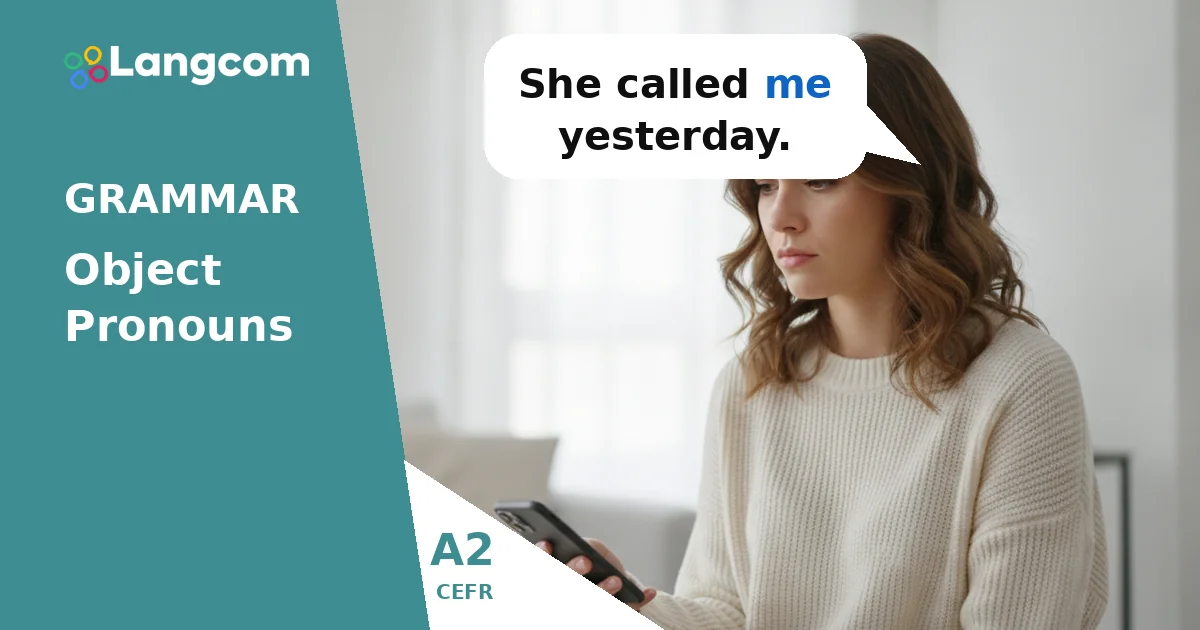
- She called me yesterday.
- Can you help us with this task?
- I gave the book to him.
- They are waiting for her.
- Look at it! It's beautiful.
- My friends invited them to the party.
- The teacher explained it to us.
练习
西班牙语母语者常犯的错误
Common Mistakes with Object Pronouns
Spanish speakers sometimes make mistakes with object pronouns because the structure can be different in Spanish. Here are some common errors:
- Using a subject pronoun instead of an object pronoun after a verb:
错误: She likes I.
正确: She likes me. - Using a subject pronoun instead of an object pronoun after a preposition:
错误: Give the book to he.
正确: Give the book to him. - 令人困惑 he/she 与 him/her: 请记住,, he 和 she *do* the action, him 和 her *receive* it.
常见问题
什么是宾语代词?
An object pronoun is a word that replaces a noun when the noun receives the action of a verb or comes after a preposition. Examples include me, him, her, us, , 和 them.
我该怎么记住主格代词和宾格代词的区别呢?
A simple way to remember is: subject pronouns *do* the action (I, he, she), and object pronouns *receive* the action (me, him, her). Think of the subject as the 'actor' and the object as the 'receiver'.
宾语代词对A2 Key考试重要吗?
是的,理解并正确使用宾语代词对于A2 Key考试非常重要。在“阅读”和“写作”部分,你可能会遇到需要选择正确的代词来补全句子,或者判断代词所指代的人或事物的题目。
宾语代词在单数和复数时会发生变化吗?
Yes, object pronouns change for singular and plural, just like subject pronouns. For example, him 和 her are singular, while us 和 them are plural.



0 条评论