

What Are Nationalities?
A nationality tells us the country a person is from. It is an adjective. It describes a person or a thing.
- He is from Italy. He is Italian.
- She is from China. She is Chinese.
We use nationalities to talk about people, food, music, and many other things.
How Do We Form Nationalities?
Many nationalities follow common patterns. You can often guess the nationality from the country name.
- -ish: For countries like Poland → Polish, Turkey → Turkish, the UK → British.
- -an / -ian: For countries like America → American, Italy → Italian, Russia → Russian, Australia → Australian.
- -ese: For countries like China → Chinese, Japan → Japanese.
- -ch / -sh: For countries like France → French, Spain → Spanish.
Some nationalities are irregular, but these patterns are a good start.
Important Rule: Capital Letters!
In English, all nationalities always start with a capital letter. This is very important.
- I am Spanish. (非 I am spanish.)
- He is American. (非 He is american.)
- This is Japanese food. (非 This is japanese food.)
Using Nationalities in Sentences
You can use nationalities in simple sentences to describe people or things.
- To say where someone is from: I am from Mexico. I am Mexican.
- To describe a person: She is a British singer.
- To describe an object: This is an Italian car.
| 国家/地区 | Nationality |
|---|---|
| Spain | Spanish |
| The UK | British |
| USA | American |
| Italy | Italian |
| China | Chinese |
| Japan | Japanese |
| Mexico | Mexican |
| Germany | German |
| France | French |
| Poland | Polish |
| Australia | Australian |
| Turkey | Turkish |
示例
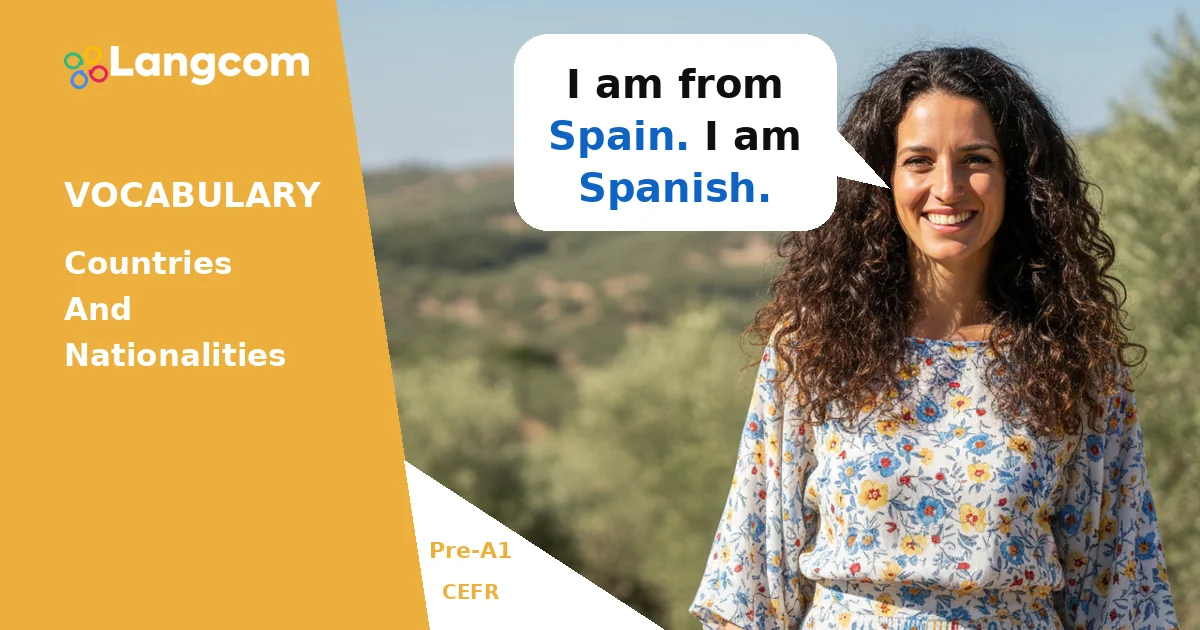
- I am from Spain. I am Spanish.
- He is from the UK. He is British.
- She is from the USA. She is American.
- We are from Poland. We are Polish.
- They are from Japan. They are Japanese.
- This is a Chinese restaurant.
练习
西班牙语母语者常犯的错误
Not Using Capital Letters
In Spanish, nationalities do not always start with a capital letter. In English, they always do!
- Correct: I am Italian.
- Incorrect: I am italian.
Using 'from' or 'of' with the Nationality
You say 'I am from [country]', but 'I am [nationality]'. Do not use 'from' or 'of' with the nationality itself.
- Correct: She is Russian.
- Incorrect: She is from Russian.
- Incorrect: She is of Russia.
Adding 'person' unnecessarily
Often, you just need the nationality adjective, not 'person' after it.
- Correct: He is French.
- Less natural: He is a French person.
常见问题
在英语中,国名总是以大写字母开头吗?
Yes, always! For example, Spanish, American, Chinese.
我可以用“国籍”来描述事物,而不仅仅是人吗?
Yes, you can. For example, you can say Japanese food, British music, 或 Italian shoes.
'美国人'是指一个国家,还是一个国籍?
American is a nationality. The country is the USA 或 the United States.




0 条评论