
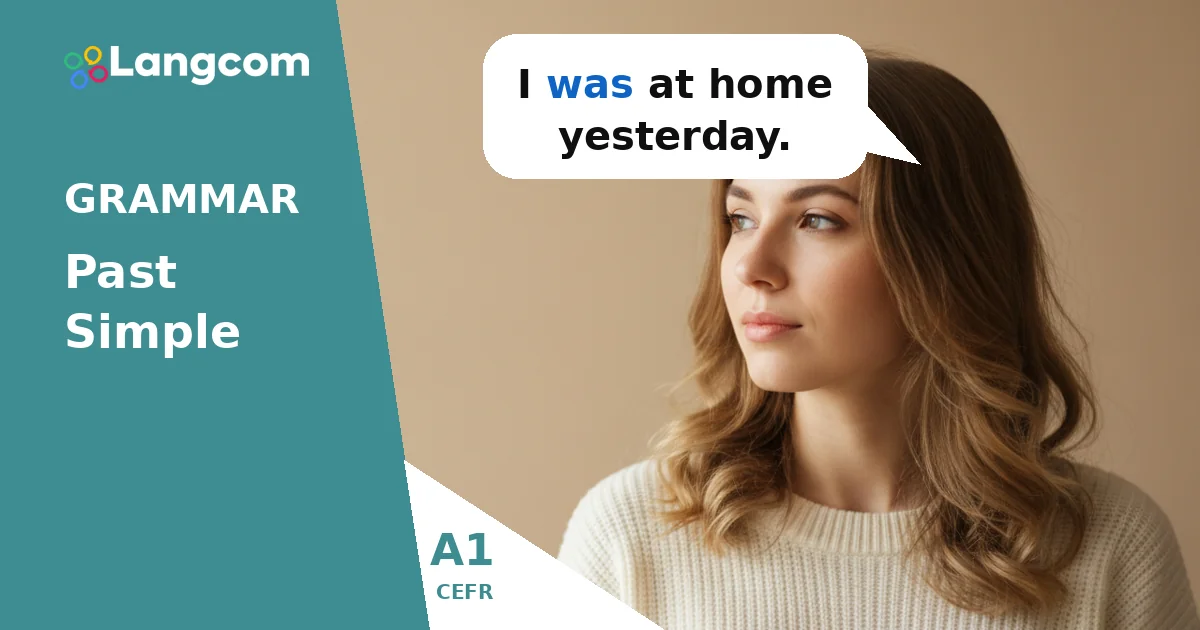

What are ‘Was’ and ‘Were’?
Was そして were are special words in English. They are the past forms of the verb to be.
We use them to talk about things that happened before now. For example, yesterday, last week, or a long time ago.
[langcom_cta variant=”blended”]
When Do We Use ‘Was’?
当社では was when the subject is singular. This means we are talking about one person or one thing.
- 使用方法 was with:
- I
- He (for a boy or man)
- She (for a girl or woman)
- It (for an animal or thing)
When Do We Use ‘Were’?
当社では were when the subject is plural. This means we are talking about more than one person or thing.
- 使用方法 were with:
- You (for one person or many people)
- We (you and other people)
- They (other people, animals, or things)
How to Make Sentences with ‘Was’ and ‘Were’
It’s easy to make sentences using was そして were. Just remember the subject and the past form.
Positive Sentences
Use: Subject + was / were + information.
- I was happy.
- They were at school.
Negative Sentences
Use: Subject + was not / were not + information.
We often use short forms: wasn’t そして weren’t.
- She was not tired. (または She wasn’t tired.)
- We were not ready. (または We weren’t ready.)
Questions
To ask a question, put was または were at the beginning of the sentence.
- Was he here? (Yes, he was. / No, he wasn’t.)
- Were you busy? (Yes, I was. / No, I wasn’t.)
For ‘Wh-‘ questions (like where, what), put the ‘Wh-‘ word first.
- Where was she?
- What were they doing?
| Subject | Past Form |
|---|---|
| I | was |
| He | was |
| She | was |
| It | was |
| You | were |
| We | were |
| They | were |
例
- I was at home yesterday.
- He was a good student.
- She was tired last night.
- It was sunny this morning.
- You were very kind.
- We were friends in primary school.
- They were late for the meeting.
- My cat was sleeping on the sofa.
- The books were on the table.
- Was your brother here?
- Were they happy with the results?
- I wasn’t hungry.
- We weren’t at the party.
練習
[langcom_cta variant=”whatsapp”]
スペイン語話者がよく犯す間違い
スペイン語を話す人たちは、次のような間違いを犯すことがあります:
- Using the wrong form: 忘れないでください、, was is for I, he, she, it そして were is for you, we, they. It is incorrect to say I were happy または You was sad.
- Forgetting ‘to be’ in the past: In English, you always need was または were to describe a past state or location. Do not say I happy yesterday (incorrect). Say I was happy yesterday (correct).
- Confusing ‘ser’ and ‘estar’: In Spanish, you have ‘ser’ and ‘estar’. In English, was そして were cover both ideas in the past. For example, I was a student (Yo era estudiante) and I was at home (Yo estaba en casa) both use was.
よくある質問
What is the difference between was and were?
The difference is the subject. We use was for singular subjects (I, he, she, it). 私たちは were for plural subjects (you, we, they).
Can was and were be used for both ‘ser’ and ‘estar’ in Spanish?
Yes, exactly! In English, was そして were are the past forms of to be, which covers both the meanings of ‘ser’ and ‘estar’ in the past. For example, She was a doctor (Ella era médica) and She was in the hospital (Ella estaba en el hospital).
How do I make a question with was or were?
To make a question, you put was または were at the beginning of the sentence, before the subject. For example, Was he busy? または Were they ready?
What are the short forms for was not and were not?
The short form for was not は wasn’t. The short form for were not は weren’t. These are very common in spoken English.




コメント 0 件