
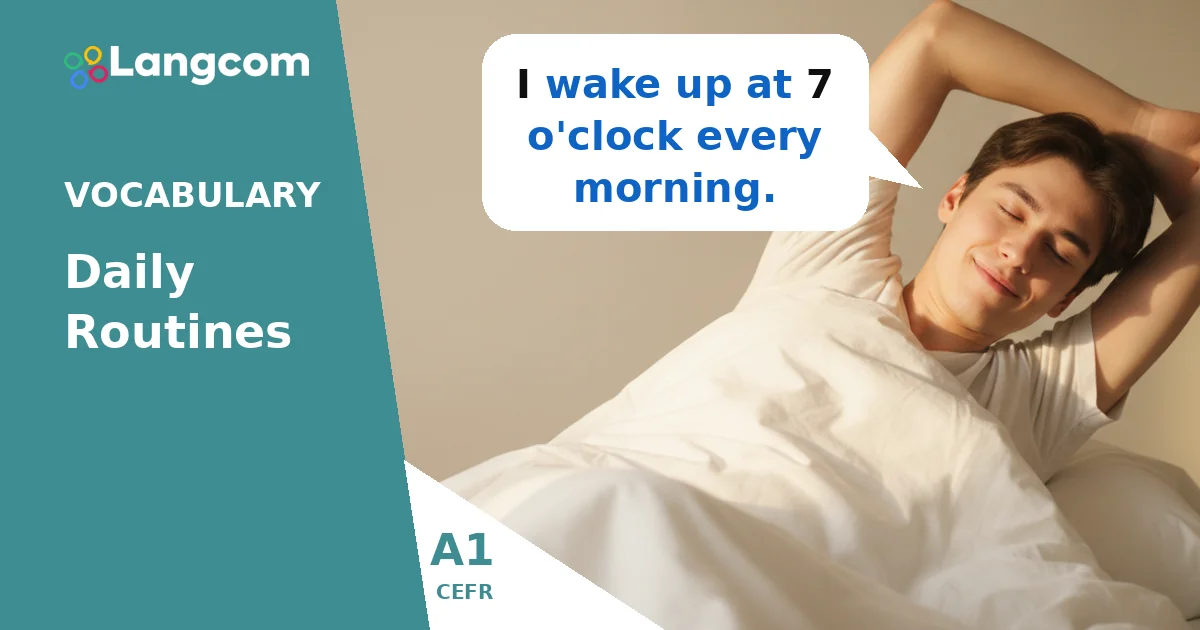

「~と~の違いは何ですか」 wake up そして get up?
These two verbs are very common for talking about your morning. They sound similar, but they have different meanings.
- Wake up means to stop sleeping. Your eyes open, and your mind becomes active. You are no longer asleep.
- You can wake up but still stay in bed.
After you wake up, you usually get up.
- Get up means to leave your bed. You move from a lying position to a standing position.
- You are no longer in bed. You are ready to start your day.
[langcom_cta variant=”blended”]
When do we use go to bed?
Go to bed is the opposite of get up. We use it when we talk about going to sleep at night.
- Go to bed means to enter your bed to sleep.
- It is the action you do before you start sleeping.
- We often say what time we go to bed.
Daily Routine Examples with these Verbs
Here are more examples to help you understand how to use wake up, get up, 、および go to bed in daily conversations.
- In the morning, my alarm rings, and I wake up.
- I often wake up before my alarm.
- After I wake up, I usually get up and make coffee.
- My children get up very early on Saturdays.
- At night, I usually go to bed at 10 p.m.
- It’s late. I need to go to bed now.
| 動詞 | 意味 | 例 |
|---|---|---|
| Wake up | Stop sleeping | I wake up at 6:30 a.m. |
| Get up | Leave your bed | I get up at 7:00 a.m. |
| Go to bed | Enter your bed to sleep | I go to bed at 10:00 p.m. |
例
- I wake up at 7 o’clock every morning.
- She wakes up, but she doesn’t get up immediately.
- He gets up and takes a shower.
- What time do you usually get up?
- They go to bed late on weekends.
- I am tired; I want to go to bed.
練習
[langcom_cta variant=”whatsapp”]
スペイン語話者がよく犯す間違い
Many Spanish speakers confuse wake up そして get up because the verb levantarse can mean both in Spanish.
- 誤り: I get up at 6 a.m., but I stay in bed. (This is wrong because get up means to leave the bed.)
- 正しい: I wake up at 6 a.m., but I stay in bed.
Another common mistake is using ‘sleep’ instead of go to bed.
- 誤り: I sleep at 11 p.m. (This means you are already sleeping at that time.)
- 正しい: I go to bed at 11 p.m. (This means you start the action of going to sleep at that time.)
よくある質問
What time do people usually wake up?
It depends on the person! Many people wake up between 6 a.m. and 8 a.m. for work or school.
こう言ってもいいですか go sleep?
No, we do not say go sleep in English. The correct phrase is go to bed. You can also say go to sleep, which means to start sleeping, but go to bed is more common for the action of entering your bed.
は get up only for mornings?
Usually, yes, we use get up for leaving bed in the morning. But you can also get up from a chair or from the floor. For example, He got up from the sofa.




コメント 0 件