
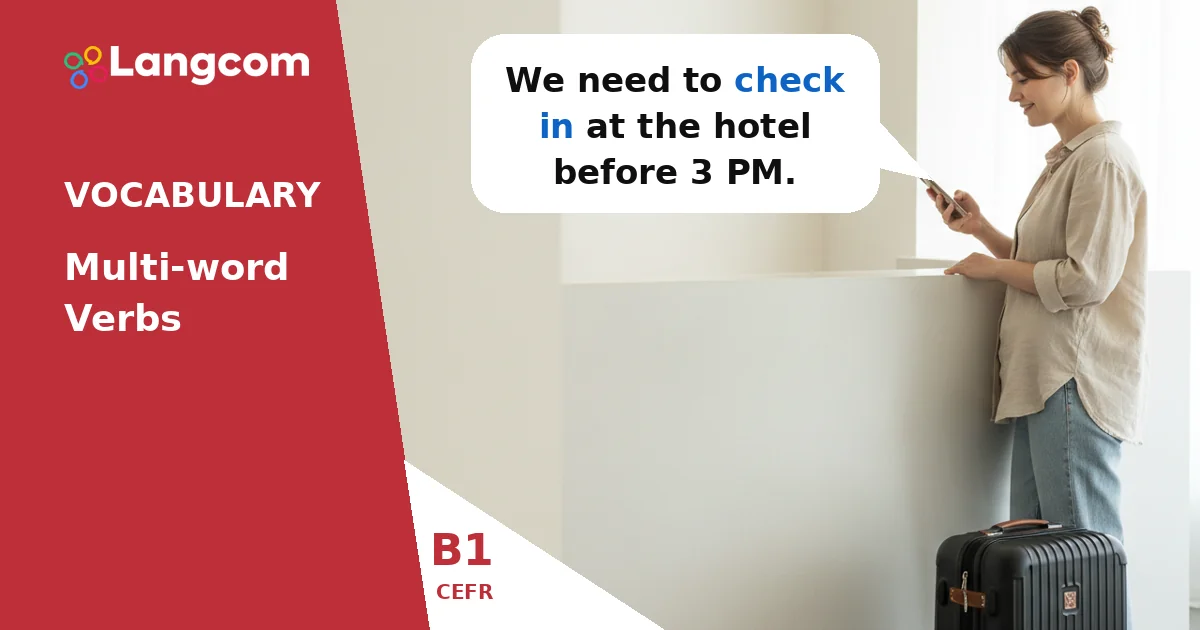

What Are Phrasal Verbs for Travel?
Phrasal verbs are a key part of English. They are verbs that combine with small words like prepositions (e.g., in, out, off) or adverbs. This combination creates a new meaning, often different from the original verb alone.
When we talk about travel, there are many common phrasal verbs that English speakers use every day. Knowing these will help you understand conversations and express yourself clearly when discussing your holidays, trips, and journeys.
Essential Travel Phrasal Verbs for B1 English
Here are some important phrasal verbs related to travel that are useful for B1 English learners:
- Check in: This means to register your arrival at a hotel or airport. You give your name and get your room key or boarding pass.
- Check out: This is the opposite of check in. It means to pay your bill and leave a hotel.
- Get away: This means to go on a holiday or a short trip, usually to relax or escape from daily life.
- Get in: This phrasal verb is used for planes, trains, or buses. It means to arrive at a destination.
- Set off: This means to begin a journey or trip. You set off from your home or starting point.
- Stop over: This means to stay somewhere for a short time during a long journey, usually before continuing to your final destination.
- Book into: This means to arrange for someone (or yourself) to stay in a hotel or other accommodation.
- Take off: This phrasal verb is used specifically for aeroplanes. It means to leave the ground and begin to fly.
Why Are Travel Phrasal Verbs Important?
Using phrasal verbs makes your English sound more natural and fluent. Native speakers use them all the time, especially in informal conversations.
For B1 learners, mastering these verbs is crucial for:
- Understanding conversations: You will easily follow discussions about travel plans and experiences.
- Speaking confidently: You can express your own travel stories and plans with more precision.
- Exam success: Phrasal verbs often appear in listening, reading, and speaking tasks in exams like the B1 Preliminary.
| Phrasal Verb | 意味 |
|---|---|
| check in | To register your arrival at a hotel or airport |
| check out | To pay your bill and leave a hotel |
| get away | To go on holiday or a short trip |
| get in | To arrive (for planes, trains, buses) |
| set off | To begin a journey |
| stop over | To stay somewhere for a short time during a journey |
| book into | To arrange for someone to stay in a hotel |
| take off | To leave the ground (for an aeroplane) |
例
- We need to check in at the hotel before 3 PM.
- All guests must check out by midday.
- I really need to get away for a few days; I'm so tired.
- The train is scheduled to get in at 5:30 PM.
- They set off early in the morning to avoid traffic.
- On our way to Australia, we decided to stop over in Dubai for a night.
- My travel agent booked us into a lovely hotel by the beach.
- The plane will take off in about twenty minutes.
練習
スペイン語話者がよく犯す間違い
Spanish speakers sometimes make mistakes with phrasal verbs because they try to translate them literally or use a single verb instead.
- Literal Translation: Do not try to translate each word separately. For example, get away does not mean 'obtener lejos'. It means 'go on holiday'.
- Using a single verb: Sometimes, a single verb can replace a phrasal verb, but the phrasal verb often sounds more natural. For example, instead of arrive, use get in for transport or check in for accommodation.
- Incorrect Particle: Using the wrong preposition or adverb can change the meaning completely or make the sentence incorrect. For example, saying check on ~の代わりに check in is a mistake. Check on means 'to verify something is okay', not 'to register'.
よくある質問
What is the difference between 'check in' and 'check out'?
You check in when you arrive at a hotel or airport to register your presence. You check out when you leave a hotel after paying your bill.
Can I use 'get in' for people arriving at a party?
No, get in is typically used for transport like planes, trains, or buses arriving at a destination. For people arriving at a party, you would usually say arrive または turn up.
How are phrasal verbs tested in the B1 Preliminary exam?
In the B1 Preliminary exam, phrasal verbs can appear in various parts. For example, in Reading Part 2 (Matching), you might need to match sentences containing phrasal verbs to descriptions. In Use of English Part 3 (Word Formation), you might need to form a phrasal verb from a base word. They are also important for understanding texts and listening passages, and for using natural language in the Speaking and Writing parts.
Is 'stop over' the same as 'stay'?
Not exactly. Stay is a general verb for remaining in a place. Stop over specifically means to stay for a short period during a longer journey, often in an intermediate city before continuing to your final destination.




コメント 0 件