

What Advanced Terms Describe Medical Conditions?
At a C1 level, you need to be precise when describing illnesses and their impacts. These terms help you discuss specific health challenges.
-
Cardiovascular disease refers to conditions affecting the heart and blood vessels. It is a broad term for serious health issues.
-
Chronic pain describes pain that lasts for a long time, often six months or more. It is different from acute pain, which is sudden and short-lived.
-
Side effects are unintended reactions to a medicine or treatment. They can be mild or severe.
How Do We Talk About Body Systems and Internal Health?
Understanding the body's internal workings requires specific vocabulary. These terms are essential for discussing diagnostics and overall health.
-
について immune system is your body's defense against infections and diseases. A strong immune system is vital for health.
-
Internal organs are the vital parts inside your body, like the heart, lungs, and liver. They perform essential functions.
-
Blood pressure is the force of blood pushing against the walls of your arteries. High or low blood pressure can indicate health problems.
-
Cholesterol levels measure the amount of fatty substances in your blood. High levels can increase the risk of heart disease.
What Vocabulary Relates to Lifestyle and Well-being?
Your daily habits and physical state significantly impact your health. These terms allow for detailed discussions about lifestyle choices and their consequences.
-
A sedentary lifestyle means spending most of your time sitting or inactive. It is often linked to various health risks.
-
Posture is the position in which you hold your body when standing or sitting. Good posture is important for spinal health.
-
Digestion is the process by which your body breaks down food to absorb nutrients. Efficient digestion is key to good health.
-
Joints are the places where two bones meet, allowing movement. Healthy joints are crucial for mobility.
-
Circulation refers to the movement of blood through the body. Good circulation ensures oxygen and nutrients reach all parts.
Why Is Advanced Health Vocabulary Essential for C1 Learners?
For C1 learners, mastering advanced health vocabulary goes beyond simple recognition. It enables you to engage in sophisticated discussions and understand complex information.
-
It allows you to read and comprehend medical news, research papers, and health policy documents in English.
-
You can articulate nuanced opinions on public health issues, preventative measures, and treatment options.
-
This vocabulary is vital for professional contexts, such as healthcare, international relations, or any field requiring detailed communication about well-being.
-
It also enhances your ability to discuss personal health concerns clearly and accurately with English-speaking professionals.
| Term | C1 Usage / Context |
|---|---|
| Cardiovascular disease | A formal term for conditions affecting the heart and blood vessels, often discussed in public health or medical reports. |
| Chronic pain | Describes persistent pain lasting over six months, requiring careful management and often impacting daily life significantly. |
| Sedentary lifestyle | Used to describe a lifestyle with minimal physical activity, often linked to increased health risks and discussed in public health campaigns. |
| Immune system | Refers to the body's defense mechanism against illness, frequently mentioned in discussions about health prevention and recovery. |
| Cholesterol levels | Measures of fatty substances in the blood, critical for assessing heart disease risk and discussing dietary impacts. |
| Side effects | Unintended reactions to medication or treatment, a crucial concept in patient information and medical consultations. |
例
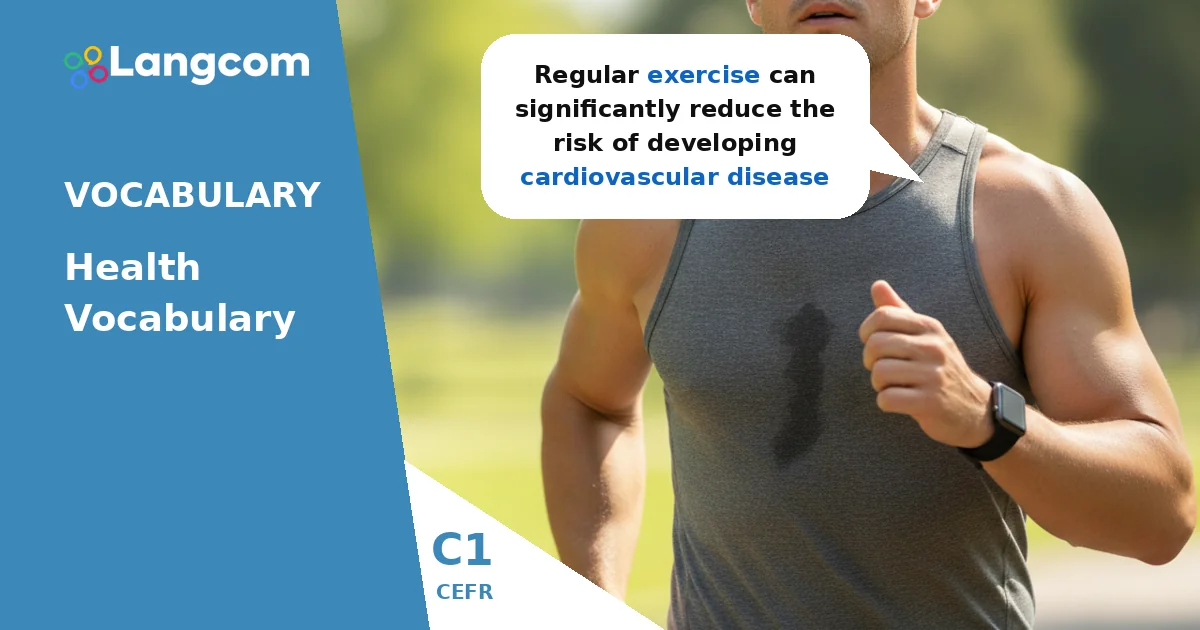
- Regular exercise can significantly reduce the risk of developing cardiovascular disease.
- She has been suffering from chronic pain in her back for several years.
- The doctor warned about the potential side effects of the new medication.
- Eating a balanced diet helps strengthen your immune system.
- An ultrasound can provide detailed images of your internal organs.
- It's important to monitor your blood pressure regularly, especially as you get older.
- High cholesterol levels are a major risk factor for heart attacks.
- A sedentary lifestyle is often associated with obesity and other health problems.
- Maintaining good posture can prevent back and neck pain.
- Certain foods can aid digestion, while others can disrupt it.
- Arthritis causes inflammation and pain in the joints.
- Poor circulation can lead to cold hands and feet.
練習
スペイン語話者がよく犯す間違い
Spanish speakers sometimes make specific errors when discussing health in English, often due to direct translation or lack of precise collocations.
- Using "ache" instead of "pain": 一方で ache is correct for a dull, continuous pain (e.g., headache, stomach ache), for more severe or long-lasting discomfort, especially in a medical context, pain is more appropriate. For example, say chronic pain, ではなく *chronic ache*.
- Incorrect adjective order: In Spanish, adjectives often follow the noun. In English, descriptive adjectives usually precede the noun. So, it's internal organs, ではなく *organs internal*, 、および sedentary lifestyle, ではなく *lifestyle sedentary*.
- Confusing "pressure" with "blood pressure": While "presión" in Spanish can refer to blood pressure, in English, you must specify blood pressure. Simply saying *my pressure is high* is ambiguous; it should be My blood pressure is high.
- Misusing "condition": Be careful not to overuse "condition" when a more specific term exists. For example, instead of *a heart condition*, you might use cardiovascular disease for a more formal or specific context.
よくある質問
What is the difference between acute pain and chronic pain?
Acute pain is sudden and usually short-term, often a signal that something is wrong, like a broken bone. Chronic pain, however, lasts for a long time, typically six months or more, and can be constant or intermittent, significantly impacting quality of life.
Can I use "bad habits" to describe a sedentary lifestyle?
While a sedentary lifestyle can be considered a "bad habit," the term sedentary lifestyle is more formal and specific in a health context. It precisely describes a lack of physical activity, which is more accurate and professional than the general term "bad habits."
Why is it important for C1 English learners to know advanced health vocabulary?
For C1 learners, advanced health vocabulary allows for more precise and sophisticated communication about complex health topics. It is essential for understanding medical news, engaging in professional discussions, and accurately expressing nuanced ideas about well-being, moving beyond basic descriptions to analytical and critical discourse.



コメント 0 件