
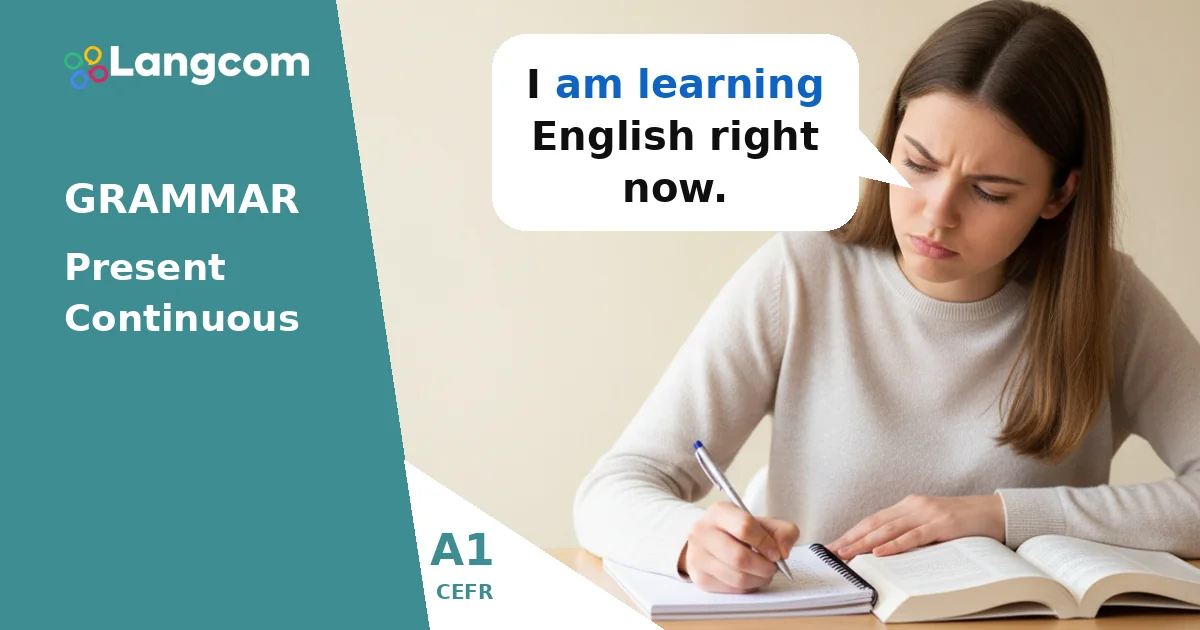

What is the Present Continuous (Positive)?
The Present Continuous helps us talk about things happening now.
It describes actions that are in progress at the moment of speaking. Think about what you are doing right now.
How Do We Form the Present Continuous (Positive)?
The structure is simple: subject + verb 'to be' (am/is/are) + main verb + -ing.
- 当社では am with I.
- 当社では is with he, she, it.
- 当社では are with you, we, they.
Contractions are common in spoken English:
- I am → I'm
- You are → You're
- He is → He's
- She is → She's
- It is → It's
- We are → We're
- They are → They're
What Are the Spelling Rules for -ing Verbs?
Here are some important rules for adding -ing to verbs:
- Most verbs: Just add -ing.
- play → playing
- read → reading
- watch → watching
- 末尾が -e: Drop the -e, その後、以下を追加します -ing.
- make → making
- have → having
- write → writing
- Short verbs (one syllable) ending in consonant-vowel-consonant (CVC): Double the last consonant, then add -ing.
- sit → sitting
- run → running
- swim → swimming
| Subject | Verb 'to be' | Main Verb + -ing | Contraction |
|---|---|---|---|
| I | am | working | I'm working |
| You | are | working | You're working |
| He | is | working | He's working |
| She | is | working | She's working |
| It | is | working | It's working |
| We | are | working | We're working |
| They | are | working | They're working |
例
- I am learning English right now.
- You are doing a great job!
- He is listening to music.
- She is cooking dinner for her family.
- It is raining outside.
- We are watching a movie together.
- They are playing football in the park.
- My sister is writing an email.
- The cat is sleeping on the sofa.
練習
💬 個別のアドバイスが必要ですか?
当校はケンブリッジ試験の公認準備センターとして、皆様に最適なコースや資格取得への道をご案内いたします。ぜひ今すぐアドバイザーにご相談ください。.
WhatsAppでアドバイザーとチャットスペイン語話者がよく犯す間違い
スペイン語話者が犯しがちな間違い
When learning the Present Continuous, Spanish speakers sometimes make specific mistakes:
- Forgetting 'to be': In Spanish, you use one verb form (e.g., estoy trabajando). In English, you need two parts: the verb 'to be' and the -ing form.
- Incorrect: I working hard.
- Correct: I am working hard.
- 誤り -ing spelling: Not dropping the -e or not doubling the consonant.
- Incorrect: She is haveing lunch.
- Correct: She is having lunch.
- Incorrect: He is runing fast.
- Correct: He is running fast.
- Confusing with Simple Present: Using Present Continuous for habitual actions instead of actions happening now.
- Incorrect: I am usually eating breakfast at 7 AM. (This describes a habit)
- Correct: I usually eat breakfast at 7 AM.
- Correct: I am eating breakfast now. (This describes an action happening now)
よくある質問
When do I use the Present Continuous?
You use it for actions happening right now, at the moment of speaking, or for temporary actions that are in progress.
Can I use contractions with the Present Continuous?
Yes, contractions like I'm, you're, he's are very common in spoken and informal written English. They make your speech sound more natural.
現在形と現在進行形の主な違いは何ですか?
The Present Simple is for habits, routines, and facts (I eat breakfast every day). The Present Continuous is for actions happening now or temporary situations (I am eating breakfast now).
Is "I am working" the same as "I work"?
No. I am working means you are working at this moment. I work means it is your job or a regular activity you do, but not necessarily right now.

コメント 0 件