
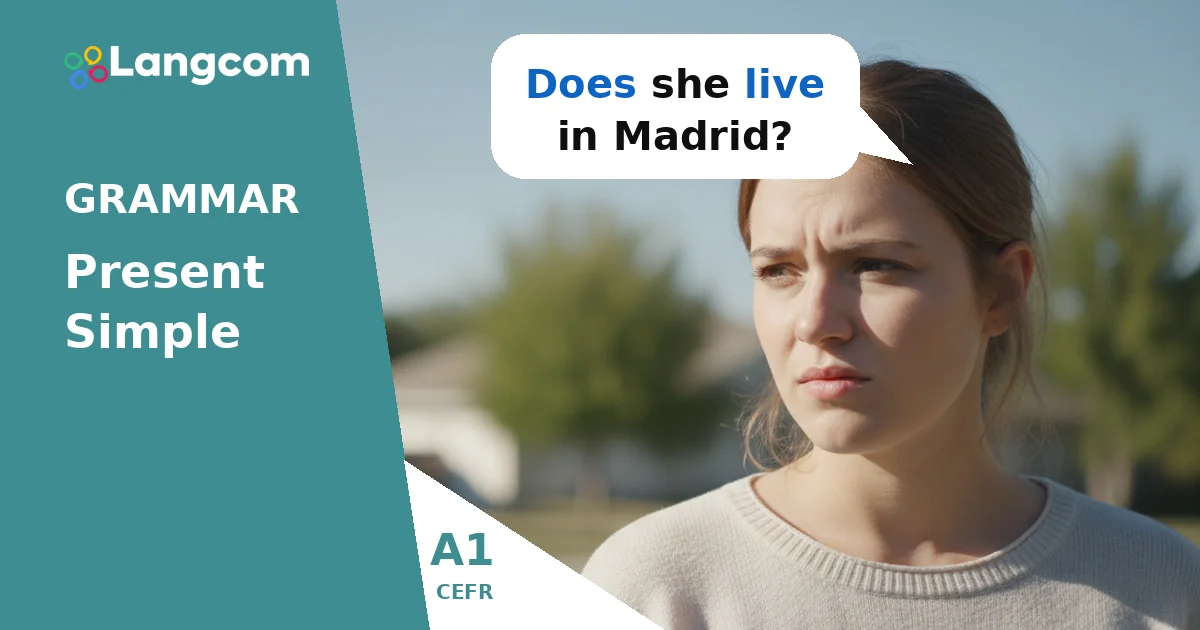

How Do We Ask Yes/No Questions About One Person?
When you want to know a simple ‘yes’ or ‘no’ answer about what someone (he, she) or something (it) does, you start your question with Does.
- First, use Does.
- Then, add the subject: he, she, 、または it.
- Next, use the main verb in its base form (without -s).
- Finally, add the rest of the sentence.
Look at the pattern:
Does + he/she/it + base verb + …?
[langcom_cta variant=”blended”]
What About Questions with ‘Who’, ‘What’, ‘Where’, ‘When’, ‘Why’, ‘How’?
If you want more specific information, you can use question words like What, Where, When, Why, 、または How. These words come at the very beginning of the question.
- Start with the question word (What, Where, etc.).
- Then, add does.
- Next, add the subject: he, she, 、または it.
- After that, use the main verb in its base form.
Look at the pattern:
Question Word + does + he/she/it + base verb + …?
How Do We Give Short Answers?
For ‘yes’ or ‘no’ questions, we often give short answers. These answers are simple and polite.
- For a positive answer, say: Yes, he/she/it does.
- For a negative answer, say: No, he/she/it doesn’t. (doesn’t is short for does not)
例
- Does she live in Madrid?
- Yes, she does.
- No, she doesn’t.
- Does he like coffee?
- What time does he wake up?
- Where does she work?
- When does the shop open?
- Why does it rain a lot here?
- How does he travel to work?
練習
[langcom_cta variant=”whatsapp”]
スペイン語話者がよく犯す間違い
Many Spanish speakers make these common mistakes:
- Adding -s to the verb: Remember, after does, the main verb is always in its base form. You should say Does she work?, ではなく Does she works?
- Forgetting does: You cannot say He lives here? for a question. You must use Does he live here?
- 使用方法 do ~の代わりに does: ~について he, she, 、および it, 常に does. So, it’s Does he play football?, ではなく Do he play football?
よくある質問
What is the main rule for ‘he/she/it’ questions in Present Simple?
The main rule is to use the helping verb does before the subject (he, she, 、または it), and then use the main verb in its base form. For example, Does she speak English?
Why do we use ‘does’ and not ‘do’ for ‘he/she/it’?
In the Present Simple, does is the special form of the verb do that we use only for third-person singular subjects: he, she, 、および it. については I, you, we, 、および they, we use do.
Does the main verb change after ‘does’?
No, the main verb never changes after does. It always stays in its base form (the infinitive without ‘to’ and without -s). For example, Does he live?, ではなく Does he lives?
Can I use ‘does’ for ‘you’ or ‘we’?
No, you cannot use does ~のために you または we. For these subjects, you must use do. 例えば、, Do you like pizza? そして Do we have class today?
What are the short answers for ‘he/she/it’ questions?
For positive short answers, you say Yes, he does., Yes, she does., 、または Yes, it does. For negative short answers, you say No, he doesn’t., No, she doesn’t., 、または No, it doesn’t.



コメント 0 件