

What Are Multi-Word Verbs in English?
Multi-word verbs are special verbs in English. They combine a main verb with one or two other small words. These small words are usually prepositions or adverbs.
The important thing is that the combination creates a new meaning. This new meaning is often very different from the meaning of the original verb alone.
- For example, give means to offer something.
- But give up means to stop trying or surrender.
Many people also call these ‘phrasal verbs’. At the B1 level, it’s important to recognize them and understand their common meanings.
How Do Multi-Word Verbs Work?
Multi-word verbs can be a bit tricky because their meaning is not always obvious. They can also be transitive (need an object) or intransitive (do not need an object).
Transitive vs. Intransitive
- Transitive: These verbs need an object. For example, I handed in my homework. (homework is the object).
- Intransitive: These verbs do not need an object. For example, The plane took off. (No object is needed after took off).
Separable vs. Inseparable
Some multi-word verbs are separable, which means you can put the object between the verb and the particle. Others are inseparable, meaning the verb and particle must stay together.
- Separable: If the object is a noun, you can put it before or after the particle. If it's a pronoun, it must go between them. For example: I turned down the offer. または I turned the offer down. If the object is it, you must say: I turned it down. (NOT I turned down it.)
- Inseparable: The verb and particle always stay together. The object always comes after the particle. For example: I look after my dog. (NOT I look my dog after.)
Don't worry too much about remembering 'separable' or 'inseparable' names. Just try to learn how each common multi-word verb is used with its object.
Common Multi-Word Verbs for B1 Level
Here are some important multi-word verbs that are very useful at the B1 level:
- Look after (inseparable): To take care of someone or something.
例: Can you look after my cat this weekend? - Put off (separable): To decide or arrange to do something at a later time; to postpone.
例: We had to put off the meeting until next week. - Carry on (inseparable): To continue doing something.
例: Please carry on with your work. - Hand in (separable): To give something to someone in a position of authority, like homework to a teacher.
例: Students must hand in their essays by Friday. - Break up (intransitive, separable for relationships): To end a relationship; also, for school, when holidays start.
例: They broke up after five years together. - Turn down (separable): To refuse an offer or request; also, to reduce the volume or intensity.
例: She turned down the job offer. - Join in (inseparable): To participate in an activity with other people.
例: Everyone was singing, so I joined in. - Feel like (inseparable): To have a desire or inclination for something or to do something.
例: I feel like eating pizza tonight. - Give up (separable): To stop trying to do something; to surrender.
例: Don't give up! You can do it. - Find out (separable): To discover information.
例: I need to find out what time the train leaves. - Take off (intransitive): For an aircraft to leave the ground; also, to remove clothes (separable).
例: The plane took off on time.
| Multi-Word Verb | 意味 |
|---|---|
| look after | to take care of |
| put off | to postpone |
| carry on | to continue |
| hand in | to submit |
| break up | to end a relationship |
| turn down | to refuse; to reduce volume |
| join in | to participate |
| feel like | to want to do/have |
| give up | to stop trying |
| find out | to discover information |
| take off | to leave the ground (plane); to remove clothes |
例
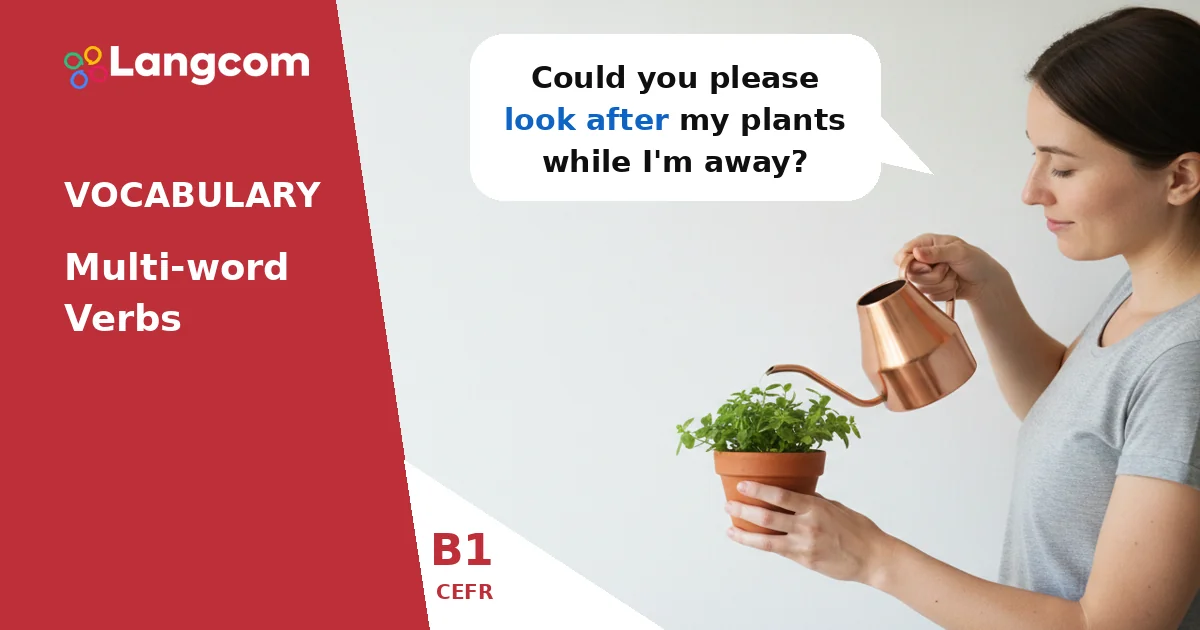
- Could you please look after my plants while I'm away?
- Don't put off your studies until the last minute.
- Even though it was raining, they carried on with the picnic.
- I forgot to hand in my report yesterday.
- Their band broke up last year.
- He turned down the music because it was too loud.
- We invited her to join in the game.
- After a long day, I don't feel like cooking.
- Never give up on your dreams.
- Did you find out who won the competition?
- Please take off your shoes before entering the house.
練習
スペイン語話者がよく犯す間違い
Spanish speakers often make a few common mistakes with multi-word verbs:
- Direct Translation: Trying to translate multi-word verbs word-for-word from Spanish. This usually doesn't work because the meaning is idiomatic. For example, you cannot say *'put away' for 'posponer' (postpone) if you mean put off.
- Forgetting the Particle: Using only the main verb when a multi-word verb is needed. For example, saying *'I looked my brother' ~の代わりに I looked after my brother (meaning 'cuidar').
- Incorrect Particle: Using the wrong preposition or adverb. For example, saying *'carry with' ~の代わりに carry on for 'continuar'. Always learn the verb and its particle together.
- Incorrect Object Placement: Placing the object incorrectly, especially with separable verbs. Remember, if the object is a pronoun, it must go between the verb and the particle: Turn it down (CORRECT) vs. *Turn down it (INCORRECT).
よくある質問
What is the difference between a phrasal verb and a multi-word verb?
The terms are often used interchangeably. Technically, 'multi-word verb' is a broader term that includes phrasal verbs, prepositional verbs, and phrasal-prepositional verbs. 'Phrasal verb' specifically refers to a verb combined with an adverb particle, like take off. For B1 learners, understanding them as verbs with particles that change meaning is the most important point.
How can I learn multi-word verbs more easily?
The best way is to learn them in context, not just as isolated words. Read English texts, listen to conversations, and pay attention to how native speakers use them. Try to group them by meaning (e.g., verbs about 'stopping' or 'continuing') or by the particle (e.g., verbs with up または down). Practice using them in your own sentences.
Are multi-word verbs formal or informal?
Many multi-word verbs are quite informal and common in everyday conversation. However, some are neutral or even formal. For example, carry out (perform a task) can be used in formal contexts. At the B1 level, you will encounter many common, everyday multi-word verbs.
Do all multi-word verbs have two words?
No, some multi-word verbs have three words, like look forward to (verb + adverb + preposition) or get on with (verb + preposition + preposition). These are also very common in English, especially at higher levels.

コメント 0 件