

What Are Food Collocations?
Collocations are words that often go together. They sound natural to native speakers. For example, we say heavy rain, ではなく strong rain.
Food collocations are specific word pairs used to talk about food. They help us describe taste, texture, and how fresh food is. Knowing these makes your English more accurate and fluent.
Describing Food Condition: Freshness and Quality
When we talk about food, its condition is very important. We use specific adjectives and verbs to describe if food is good to eat or not.
- Ripe: This adjective is used for fruit or vegetables that are ready to eat. They are fully developed and taste good.
- Rotten: This means fruit or vegetables are spoiled and no longer good to eat. They might smell bad or have mould.
- Go off / Go bad: These phrasal verbs describe food that is no longer fresh. Go off is common for dairy products like milk, while go bad can be used for meat or other foods.
- Tough: This describes meat that is difficult to chew and cut. It is the opposite of tender.
- Fresh produce: This refers to fruit, vegetables, and other farm products that are newly harvested or made.
Describing Food Taste and Texture
We use a variety of adjectives to talk about how food tastes or feels in our mouth.
- Rich: This describes food that has a strong, full flavour, often because it contains a lot of fat, sugar, or strong ingredients. For example, rich chocolate cake.
- Mild: This means a flavour is not strong or spicy. It is gentle and pleasant. For example, mild curry.
- Weak: This is often used for drinks like coffee or tea that do not have a strong flavour. It means too much water was added.
- Juicy: This describes food, especially fruit or meat, that contains a lot of liquid and is pleasant to eat.
Why Are Food Collocations Important for B2 First?
At the B2 level, your English should sound natural and fluent. Using collocations helps you achieve this. The B2 First exam tests your ability to use a wide range of vocabulary accurately.
- 発言: You can describe meals, discuss healthy eating, or talk about cooking with more precision.
- Writing: You can write reviews of restaurants or describe food in stories more effectively.
- Listening and Reading: Understanding collocations helps you comprehend native speakers and texts better.
Using these specific word combinations shows a higher level of language proficiency.
| Adjective/Verb | Common Noun/Context | 意味 |
|---|---|---|
| Ripe | Fruit, vegetables | Ready to eat, fully developed |
| Rotten | Fruit, vegetables | Spoiled, no longer good to eat |
| Go off | Milk, dairy products | Become spoiled, no longer fresh |
| Go bad | Meat, general food | Become spoiled, unfit to eat |
| Tough | Meat | Difficult to chew or cut |
| Rich | Food, sauce, cake | Strong, full flavour; often high in fat/sugar |
| Mild | Flavour, curry, cheese | Not strong or spicy, gentle |
| Weak | Coffee, tea | Not strong in flavour (e.g., too much water) |
| Juicy | Fruit, meat | Containing a lot of liquid, pleasant to eat |
例
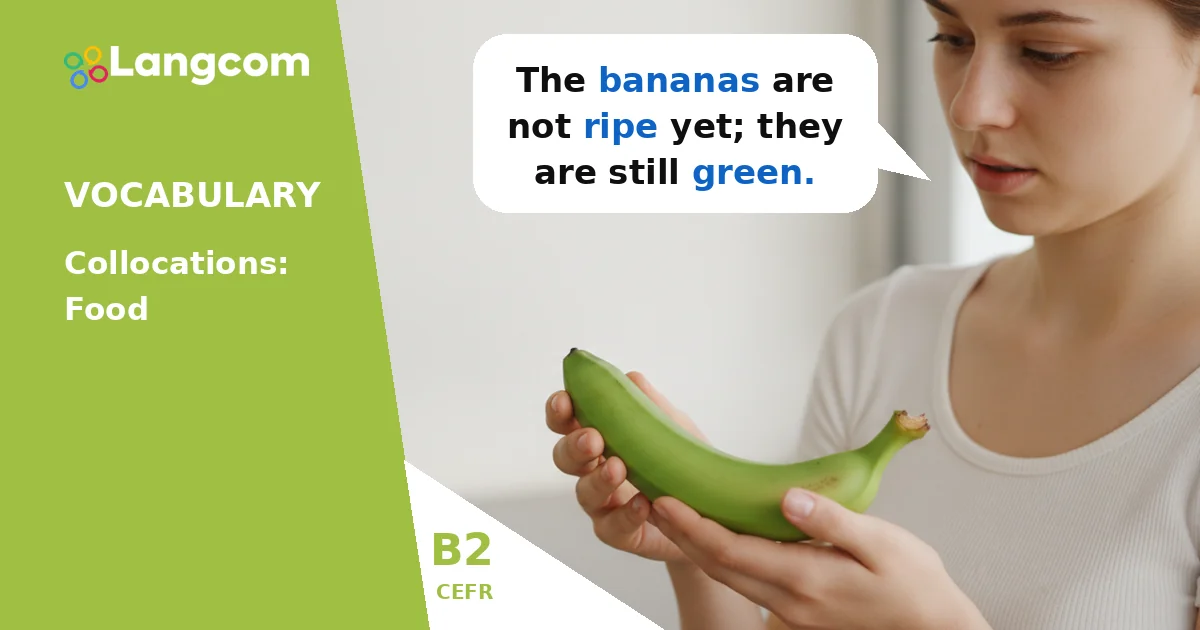
- The bananas are not ripe yet; they are still green.
- I had to throw away the apples because they were rotten.
- Don't drink that milk; it has gone off.
- The meat went bad quickly because I left it out of the fridge.
- This steak is too tough; I can barely cut it.
- After eating such a rich dessert, I feel very full.
- I prefer a mild curry that isn't too spicy.
- This coffee is a bit weak for my taste.
- The oranges were incredibly juicy and refreshing.
練習
スペイン語話者がよく犯す間違い
Spanish speakers often make mistakes with food collocations due to direct translation. Here are some common ones:
- Ripe fruit 対. Mature fruit: In Spanish, you might say 'fruta madura'. However, in English, for fruit ready to eat, we say ripe fruit, ではなく mature fruit. Mature is usually for people or processes.
- Meat is tough 対. Meat is hard: Spanish 'carne dura' can be translated as hard meat, but this is incorrect. For meat that is difficult to chew, the correct collocation is tough meat.
- Milk went off 対. Milk became bad: While understandable, milk became bad is not natural. The correct and common collocation is milk went off.
- Rich food 対. Heavy food: When food has a lot of fat or sugar, making it filling, we say rich food. Saying heavy food (from 'comida pesada') is less common and can mean food that is physically heavy.
よくある質問
What is the difference between 'rotten' and 'gone off'?
Rotten is typically used for solid foods like fruit and vegetables that are visibly spoiled. Gone off is more commonly used for dairy products (like milk) or other liquids that have become bad. For example, a rotten apple but milk that has gone off.
Can I use 'strong' instead of 'rich' for food?
No, not usually. Strong describes a powerful flavour, like strong cheese または strong coffee. Rich describes food that is very full-flavoured and often high in fat or sugar, making it very filling, like rich chocolate cake. They are not interchangeable.
How do food collocations help with the B2 First exam?
Mastering food collocations is essential for the B2 First exam, especially in the Speaking and Writing papers. Using natural collocations like ripe fruit または mild flavour shows a broader and more accurate vocabulary, which contributes to a higher score in the Lexical Resource criteria. For example, in Part 2 of the Speaking test, you might describe a picture of food, and using precise collocations will impress the examiner.
Is 'fresh' a collocation?
はい、, fresh often forms collocations with many food items, such as fresh bread, fresh vegetables, 、または freshly squeezed juice. It means the food is new, recently made, or not preserved.




コメント 0 件