

What Are Comparatives and Superlatives?
When we talk about things, we often want to compare them. Maybe one thing is bigger, or one is more beautiful.
- Comparatives help us compare two things.
- Superlatives help us compare three or more things. They show which thing is the ‘most’ or ‘least’ of a group.
How Do We Compare Two Things with Long Adjectives?
For long adjectives, we use the word more to compare two things.
- The rule is: more + adjective + than.
- 当社では than after the adjective to show what we are comparing it to.
For example, if you think a book is interesting, and another book is even more so, you can say: This book is more interesting than that book.
How Do We Compare Three or More Things with Long Adjectives?
When we compare three or more things and want to say which one is number one (the best, the biggest, etc.), we use the word the most.
- The rule is: the most + adjective.
- We always use the 以前 most.
For example, if you think a movie is exciting, and it's the best of all the movies, you can say: It is the most exciting movie.
What Is a Long Adjective?
In English, adjectives can be 'short' or 'long'. Long adjectives usually have two or more syllables (parts of a word).
- Examples of long adjectives are: beautiful (beau-ti-ful), expensive (ex-pen-sive), difficult (dif-fi-cult), important (im-por-tant).
- We do not add -er または -est to these words. We use more そして the most instead.
| 形容詞 | Comparative (2 things) | Superlative (3+ things) |
|---|---|---|
| important | more important | the most important |
| beautiful | more beautiful | the most beautiful |
| difficult | more difficult | the most difficult |
| expensive | more expensive | the most expensive |
| interesting | more interesting | the most interesting |
例
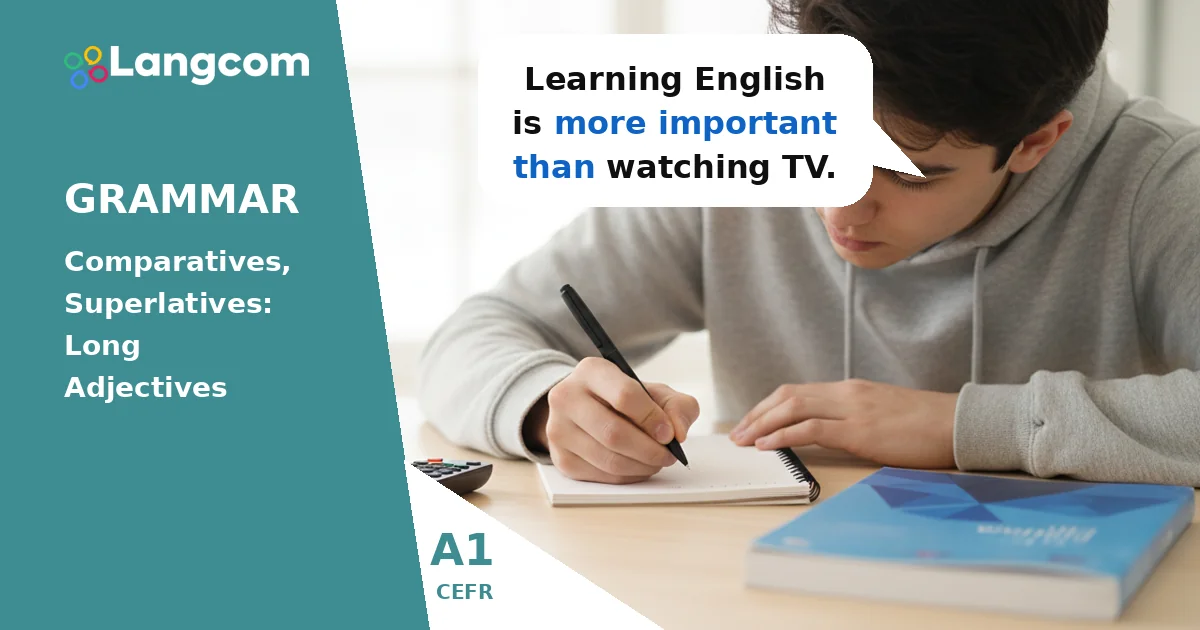
- Learning English is more important than watching TV.
- This car is more expensive than that bicycle.
- The blue dress is more beautiful than the red skirt.
- Mount Everest is the most famous mountain in the world.
- That exam was the most difficult test of the year.
- She is the most intelligent student in the class.
練習
💬 個別のアドバイスが必要ですか?
当校はケンブリッジ試験の公認準備センターとして、皆様に最適なコースや資格取得への道をご案内いたします。ぜひ今すぐアドバイザーにご相談ください。.
WhatsAppでアドバイザーとチャットスペイン語話者がよく犯す間違い
Common Mistakes with Long Adjectives
Many Spanish speakers make these common mistakes:
- Adding -er または -est to long adjectives:
INCORRECT: This book isinterestinger.
CORRECT: This book is more interesting. - Forgetting the 以前 most for superlatives:
INCORRECT: It wasmost difficultday.
CORRECT: It was the most difficult day. - 使用方法 more または most with short adjectives: (This lesson is about long adjectives, but be careful!)
INCORRECT: My brother ismore tall.
CORRECT: My brother is taller.
よくある質問
What is a long adjective?
A long adjective is a word that describes a noun and usually has two or more syllables (parts). For example, beautiful, important, 、および expensive are long adjectives.
Can I say 'expensiver' or 'beautifulest'?
No, you cannot say expensiver または beautifulest. For long adjectives, we always use more for comparatives and the most for superlatives. So, it's more expensive そして the most beautiful.
When do I use 'more' and when 'the most'?
あなたは more when you compare two things (e.g., This car is more comfortable than that one.). You use the most when you compare three or more things and want to show which one is number one in a group (e.g., This is the most comfortable car in the shop.).




コメント 0 件