

How do we show small differences in comparisons?
When you want to say that two things are only a little bit different, you can use these words:
- a bit
- a little
- slightly
You can also use not much または not a lot to show a small difference.
- She is a bit taller than her sister. (The difference in height is small.)
- The exam was slightly more difficult than last year’s. (It was a little harder, but not much.)
- My new car isn’t much faster than my old one. (The speed difference is small.)
How do we show big differences in comparisons?
If the difference between two things is large, use these words:
- much
- far
- a lot
These words make the comparison stronger.
- This book is much more interesting than the last one I read. (The difference in interest is big.)
- He runs far quicker than me. (His speed is significantly higher.)
- Learning English is a lot easier with Langcom! (It's much simpler and more effective.)
When do we use as ... as for comparisons?
We use the structure as + adjective/adverb + as to say that two things are the same or equal in some way.
- My house is as big as yours. (Our houses have the same size.)
- She sings as beautifully as a professional. (Her singing ability is equal to a professional's.)
- Today is as warm as yesterday. (The temperature is the same.)
When do we use not as ... as for comparisons?
当社では not as + adjective/adverb + as to say that one thing is less than another, or not equal.
This structure means the first item has less of the quality than the second item.
- This coffee isn't as hot as I like it. (The coffee is less hot than my preference.)
- He doesn't speak English as fluently as his brother. (His brother speaks English more fluently.)
- The old phone wasn't as smart as the new models. (New models are smarter.)
| Modifier | 意味 | 例 |
|---|---|---|
| a bit, a little, slightly | Small difference | The new phone is a bit heavier. |
| much, far, a lot | Big difference | Learning English is much easier now. |
| as ... as | Equal | She is as smart as her brother. |
| not as ... as | Not equal / Less | The old car isn't as fast as the new one. |
例
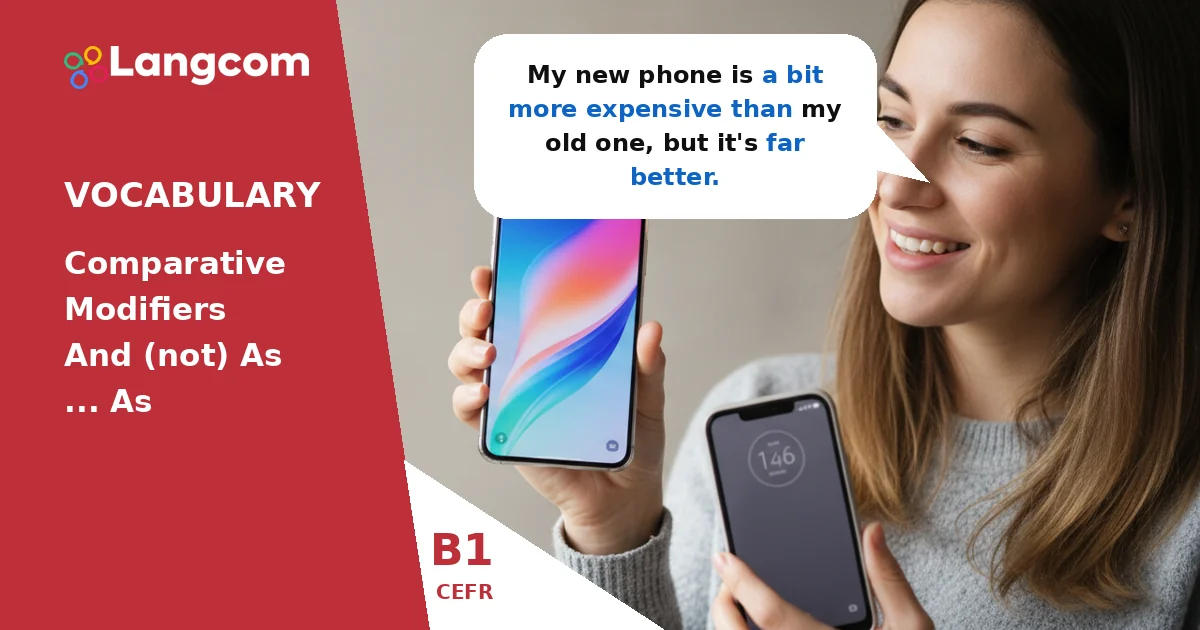
- My new phone is a bit more expensive than my old one, but it's far better.
- This city isn't as crowded as London.
- She is a bit taller than her sister.
- The exam was slightly more difficult than last year's.
- My new car isn't much faster than my old one.
- This book is much more interesting than the last one I read.
- He runs far quicker than me.
- Learning English is a lot easier with Langcom!
- My house is as big as yours.
- She sings as beautifully as a professional.
- Today is as warm as yesterday.
- This coffee isn't as hot as I like it.
- He doesn't speak English as fluently as his brother.
- The old phone wasn't as smart as the new models.
練習
スペイン語話者がよく犯す間違い
Be careful to avoid these common errors when using comparative modifiers:
- 使用方法 very with comparatives: Many Spanish speakers might say
very better. This is incorrect. Always use much, far, 、または a lot with comparative adjectives. For example, say much better, ではなくvery better. - Forgetting the second as で as ... as: It's common to forget the second as. 例えば、,
She is as tall than meis wrong. The correct form is She is as tall as me. - Incorrect word order with not as ... as: Make sure not comes before as. 例えば、,
This isn't as big as thatis correct, butThis is as not big as thatis incorrect. - 使用方法 more ~と as ... as: The structure as ... as already implies comparison. Do not add more. 例えば、,
He is as more intelligent as heris wrong. Say He is as intelligent as her.
よくある質問
Can I use 'very' with comparative adjectives?
いいえ、使用することはできません very with comparative adjectives. Instead, use much, far, 、または a lot to show a big difference. For example, say This car is much faster, ではなく This car is very faster.
What is the difference between 'a bit' and 'a lot'?
A bit shows a small difference. For example, It's a bit colder today. A lot shows a large difference. For example, It's a lot colder today. Both are used with comparative adjectives.
Is 'not as ... as' the same as a comparative with 'less'?
Yes, they often have similar meanings. For example, This book isn't as interesting as that one means the same as This book is less interesting than that one. Both show that the first item has less of a quality than the second.
How are these modifiers used in the B1 Preliminary exam?
In the B1 Preliminary exam, you might need to use these comparative modifiers in the Writing Part 2 (e.g., describing differences in a short message or story) or Speaking Part 2 (e.g., comparing two photos). They help you describe similarities and differences clearly and precisely.




コメント 0 件