

可算名詞としても不可算名詞としても使える名詞にはどのようなものがありますか?
英語では、ほとんどの名詞は、厳密に可算名詞であるか(例: a chair, two chairs) あるいは厳密に不可算名詞(例: water, information). ただし、名詞の中には柔軟な用法を持つものもあります。
こうした特殊な名詞は、可算名詞としても不可算名詞としても機能しますが、その意味は変化します。この柔軟性により、より豊かな表現が可能となり、上級レベルの英語ではよく見られる特徴です。
なぜこれがC1レベルの英語学習者にとって重要なのでしょうか?
C1レベルでは、より正確かつ微妙なニュアンスを込めて英語を使う必要があります。名詞が可算名詞か不可算名詞かを誤解すると、次のような事態を招く可能性があります:
- 文法の誤り(例: a/an (または複数形を誤って使用している場合)。
- 伝達上の誤解(例:一般的な概念と特定の事柄を混同すること)。
- 複雑な文章や話し言葉の英語を理解するのが難しい。
これらの名詞を習得することは、英語の意味論に対する深い理解を示しています。
よく使われる二重の意味を持つ名詞を探る
可算名詞としても不可算名詞としても使える一般的な名詞をいくつか見て、その意味がどのように変わるかを確認してみましょう:
Art
- 不可算名詞: 創造的な表現や技能という一般的な概念を指す。
Art is a powerful way to communicate emotions. - 可算名詞: 特定の芸術作品、あるいは特定の種類の芸術や芸術形式を指す。
The gallery displayed several modern arts. (つまり、絵画や彫刻など、さまざまな種類の芸術のこと)
She bought an art for her living room. (つまり、芸術作品を指すが、 a piece of art (より一般的です)
Business
- 不可算名詞: 商品やサービスの売買という一般的な活動、あるいは人の職業を指す。
Business is booming this quarter.
He travels a lot on business. - 可算名詞: 特定の会社、店舗、または事業体を指します。
My aunt owns a small business in the city center.
They are planning to open three new businesses next year.
Chicken
- 不可算名詞: 食用として用いられる鶏の肉を指す。
Would you like some chicken for dinner? - 可算名詞: 生きている鳥を指す。
The farmer has many chickens on his farm.
A chicken laid an egg this morning.
Disease
- 不可算名詞: 一般的な病気、あるいは病気の状態を指す。
Research into disease is crucial for public health. - 可算名詞: 特定の病気や病状を指します。
Malaria is a serious disease that affects millions.
There are many different diseases that can affect humans.
Exercise
- 不可算名詞: 一般的な身体活動、あるいはトレーニングの行為を指す。
Regular exercise is vital for a healthy lifestyle. - 可算名詞: 練習のために与えられる、特定の身体の動き、課題、または問題を指す。
I do three different exercises every morning.
The teacher gave us a difficult exercise to complete.
Speech
- 不可算名詞: 話すという一般的な能力、あるいは話し言葉のことを指す。
Human speech is a complex form of communication. - 可算名詞: 聴衆に向けて行われる正式な講演、あるいは特定の発言を指す。
The president delivered an inspiring speech.
He gave a short speech at the wedding.
| 名詞 | 不可算名詞の意味と例 | 可算名詞の意味と例 |
|---|---|---|
| Art | 一般的な創造的表現: Art is subjective. | 具体的な作品/種類: The museum has many arts. |
| Business | 一般的な活動・職業: Business is slow. | 企業/事業体: He owns a small business. |
| Chicken | 食品としての肉: I like chicken. | 生きた鳥: We have three chickens. |
| Disease | 病気全般: Research into disease. | 特定の病気: Malaria is a disease. |
| Exercise | 身体活動: Daily exercise is good. | 具体的な動作・作業: Do these exercises. |
| Speech | 会話能力: Human speech is unique. | 正式な講演: He gave a great speech. |
例
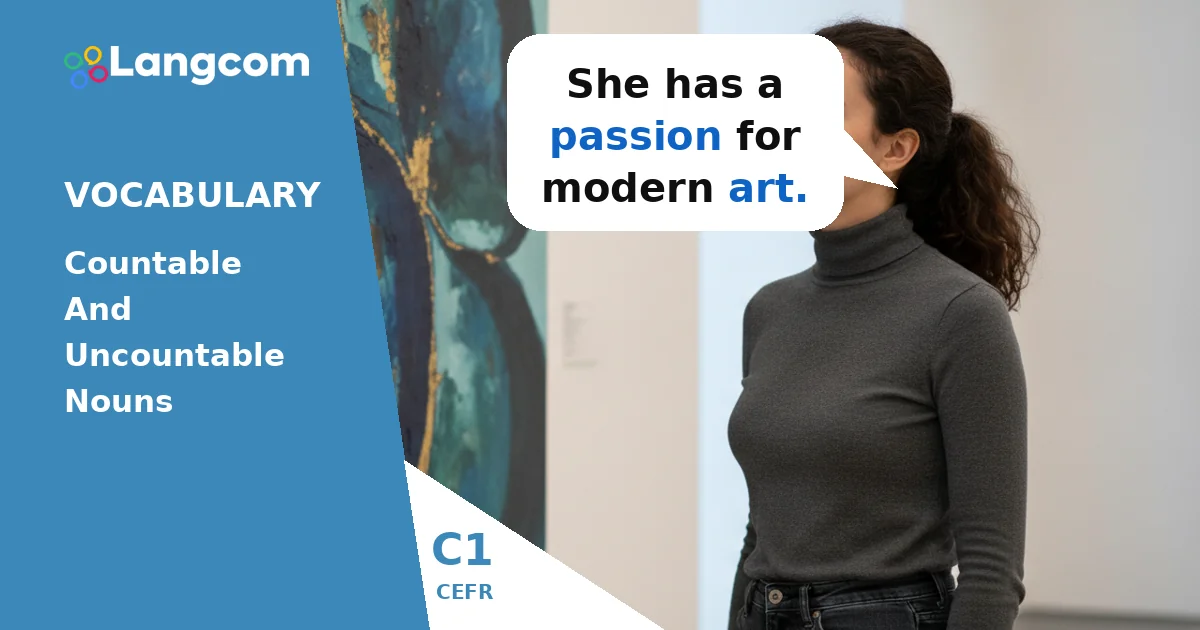
- She has a passion for modern art.
- The museum acquired several new arts for its collection.
- Starting a new business requires a lot of capital.
- Business is all about taking calculated risks.
- We had roast chicken for Sunday lunch.
- The fox tried to catch a chicken from the coop.
- Prevention is better than cure when it comes to disease.
- Heart disease is a leading cause of death worldwide.
- I need to get more exercise to stay fit.
- The warm-up included five different exercises.
- Freedom of speech is a fundamental right.
- Her speech lasted for almost an hour.
練習
スペイン語話者がよく犯す間違い
Spanish speakers sometimes make mistakes with these nouns because Spanish often treats similar concepts differently. Here are common errors:
- 使用方法 a/an with uncountable meanings:
❌ I need an advice.
✅ I need some advice. (または a piece of advice) - Pluralizing uncountable nouns:
❌ We discussed many informations.
✅ We discussed a lot of information. (または many pieces of information) - Confusing general concept with specific item:
If you mean the general concept of 'work' (uncountable), do not say a work. A work refers to a specific creation, like a painting or a book.
❌ I have a lot of works to do. (meaning tasks)
✅ I have a lot of work to do.
✅ Picasso's early works are fascinating. (meaning artworks)
よくある質問
同じ名詞の「可算名詞」としての用法と「不可算名詞」としての用法には、どのような主な違いがありますか?
The main difference lies in meaning and grammatical behavior. When a noun is uncountable, it refers to a general concept, a substance, or an activity (e.g., knowledge, water, music). It cannot be pluralized or used with a/an. When the same noun is countable, it refers to a specific item, instance, or type (e.g., a piece of knowledge, a bottle of water, a song). It can be pluralized and used with a/an.
文の中で、名詞が可算名詞か不可算名詞かを見分けるにはどうすればよいですか?
Look at the context and the words around the noun. If you see a/an, a number, or a plural form, it's being used as countable. If you see quantifiers like much, little, some (without a/an), or no article, it's likely uncountable. Also, consider the meaning: is it a general idea or a specific item?
この知識が問われる具体的なC1 Advancedの試験課題はありますか?
Yes, this knowledge is vital across several parts of the C1 Advanced exam. In Reading and Use of English Part 1 (Multiple-choice cloze), you might need to choose the correct word form or quantifier. In Part 3 (Word formation), forming nouns from verbs or adjectives might require understanding their countable/uncountable nature. In Writing そして Speaking, accurate use of these nouns is essential for clarity and achieving a high lexical resource score.



コメント 0 件