
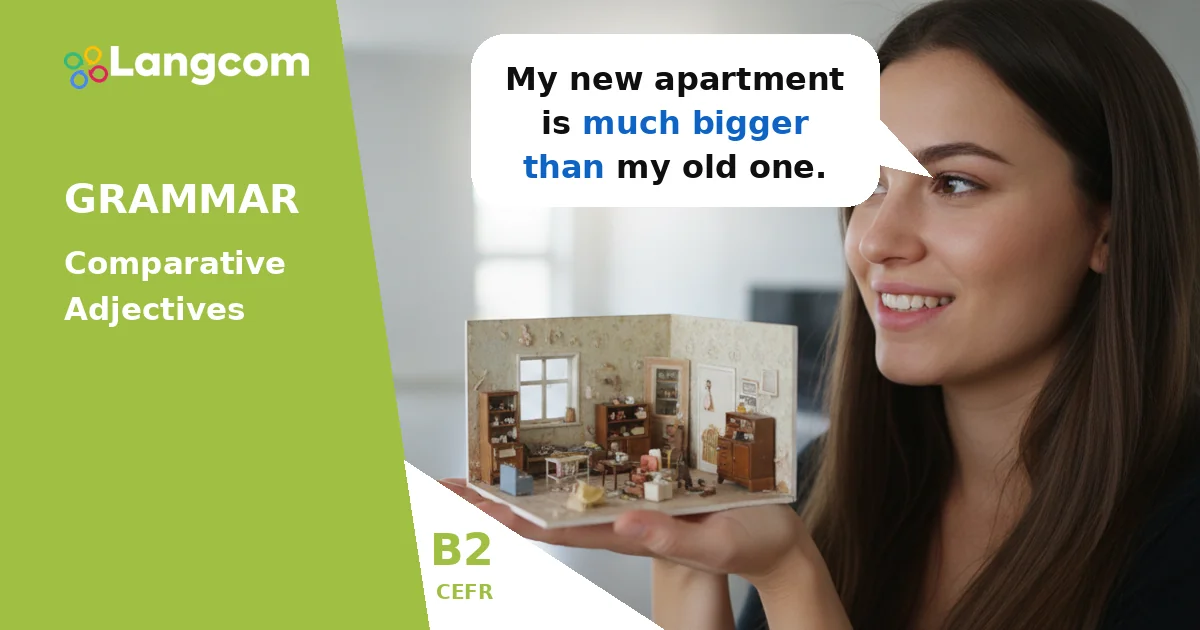

What Are Comparative Adjectives?
Comparative adjectives help us compare two things, people, or ideas. They show a difference, indicating that one item has more of a quality than another. We use them to say something like This book is more interesting than that movie.
The structure for a basic comparison is usually: Subject + verb + comparative adjective + than + object.
✍️ Vous ne savez pas quel est votre niveau ?
Passez notre test de niveau gratuit et recevez des commentaires personnalisés de la part d'examinateurs certifiés par Cambridge.
Passez notre test de niveau GRATUITHow Do We Form Comparative Adjectives?
The way we create a comparative adjective depends on the number of syllables in the original adjective. There are specific rules for short adjectives, longer ones, and some irregular forms.
- For most one-syllable adjectives, we add -er.
- For two-syllable adjectives ending in -y, we change -y à -ier.
- For most other two-syllable adjectives and all longer adjectives, we use more before the adjective.
- Some adjectives have irregular comparative forms.
One-Syllable Adjectives: Adding -er
For most adjectives with one syllable, we simply add -er to the end to form the comparative.
- tall → taller
- old → older
- fast → faster
Spelling Rule: If a one-syllable adjective ends in a single vowel + single consonant (CVC pattern), we double the final consonant before adding -er. This does not apply if the consonant is w.
- big → bigger (b-i-g)
- hot → hotter (h-o-t)
- thin → thinner (t-h-i-n)
Two-Syllable Adjectives Ending in -y: Changing -y to -ier
When a two-syllable adjective ends with a consonant followed by the letter y, we change the y à i and then add -er.
- happy → happier
- easy → easier
- heavy → heavier
Longer Adjectives: Using 'more'
For most two-syllable adjectives that do not end in -y, and for all adjectives with three or more syllables, we use the word more before the adjective.
- careful → more careful
- expensive → more expensive
- intelligent → more intelligent
Adjectives with Two Possible Forms
Some two-syllable adjectives can form their comparative in two ways: by adding -er or by using more. Both forms are generally correct.
- simple → simpler OR more simple
- clever → cleverer OR more clever
- polite → politer OR more polite
Other common adjectives in this group include common, cruel, gentle, likely, narrow, pleasant.
Irregular Comparative Adjectives
Some common adjectives do not follow the regular rules. You need to memorize their irregular comparative forms.
- good → better
- bad → worse
- far → farther / further
- old → older / elder
Note on farther et further: Farther typically refers to physical distance (London is farther than Manchester.). Further can also refer to physical distance but is more commonly used for abstract ideas or additional information (I need further details.).
Note on older et elder: Older is used for people and things (My car is older than yours.). Elder is used only for people, specifically family members, and is less common (My elder sister lives abroad.).
Making Comparisons Stronger or Weaker: Adverbs of Degree
We can use adverbs of degree to make a comparative adjective stronger or weaker. These adverbs come before the comparative form.
- To make it stronger: much, a lot, a great deal, far
- To make it weaker: a bit, a little, slightly, rather
For example:
- This book is much more interesting than that one.
- She is a little taller than her brother.
- The new phone is slightly more expensive.
| Adjective Type | Rule | Exemple |
|---|---|---|
| One-syllable | Add -er (double final consonant if CVC) | tall → taller, big → bigger |
| Two-syllable ending in -y | Change -y à -ier | happy → happier |
| Most other two-syllable & all longer | Use more + adjective | careful → more careful, expensive → more expensive |
| Some two-syllable (e.g., simple) | Both -er ou more + adjective | simpler / more simple |
| Irregular | Memorize special forms | good → better, bad → worse |
Exemples
- My new apartment is much bigger than my old one.
- Learning English is often easier than learning German for Spanish speakers.
- This task is more challenging than the last one.
- He feels happier now that he has a new job.
- The train journey was a bit longer than we expected.
- Could you give me further information about the course?
- My elder brother is a doctor.
- The weather today is worse than yesterday.
Entraînement
Ready to earn your certificate?
Langcom prepares students for Cambridge, IELTS, TOEFL, DELE, SIELE and Michigan exams.
Get started with LangcomErreurs courantes chez les hispanophones
Spanish speakers sometimes make specific errors when using comparative adjectives:
- Using more with -er: Do not say more faster. The correct form is faster. Remember, it's either -er OR more, but not both for the same adjective.
- Forgetting than: In Spanish, you might use "que" for comparison. In English, always use than after the comparative adjective. For example, She is taller than him, et non She is taller him.
- Incorrect spelling for CVC adjectives: Forgetting to double the final consonant can lead to errors like biger instead of bigger.
- Confusing farther et further: While often interchangeable for distance, remember further is preferred for abstract or additional meaning.
Questions fréquemment posées
What is the difference between farther and further?
Farther usually refers to physical distance (e.g., The next town is farther than this one.). Further can also mean physical distance but is more commonly used for abstract ideas, additional information, or progress (e.g., Do you have any further questions?).
Can I use more with short adjectives?
Generally, no. For most one-syllable adjectives, you must use the -er ending (e.g., taller, et non more tall). Some two-syllable adjectives have both options, as explained above.
How do comparative adjectives appear in the B2 First exam?
Comparative adjectives are often tested in the B2 First (FCE) Use of English Part 2 (Open Cloze) and Part 3 (Word Formation). You might need to correctly form a comparative adjective from a base adjective or choose the correct adverb of degree to complete a sentence.
What is the difference between older and elder?
Older is the standard comparative for old and can refer to people or things (e.no-translation.g., My car is older than yours.). Elder is only used for people, specifically within a family, and is less common in modern English (e.g., My elder brother is a teacher.).


0 commentaire