
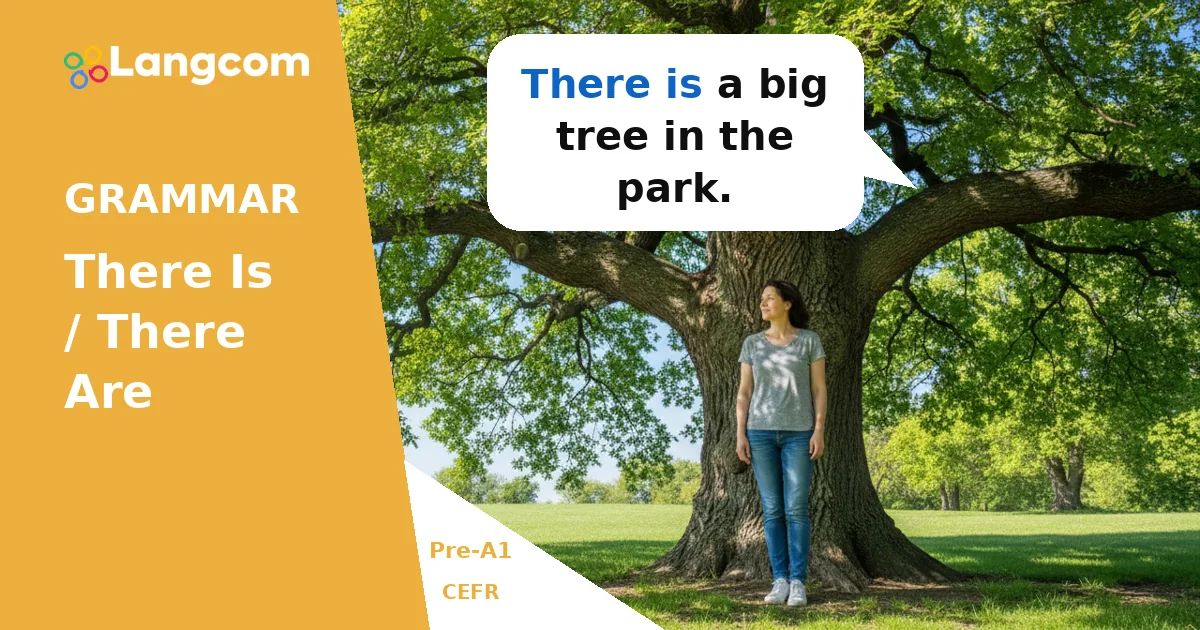

What are ‘There is’ and ‘There are’?
There is and There are are special phrases in English. We use them to say that something exists in a place.
Think of them like “Hay” in Spanish. They tell us “what” is in a location.
🎓 Learn English with the Blended method
Small groups · 24/7 AI Tutor · Cambridge preparation
Plans from $39 $79 per month
How to Use ‘There is’ (Singular and Uncountable)
Use There is for one person or one thing (singular nouns).
We also use There is for uncountable nouns, like water, sugar, or information.
- There is a pen on the desk. (one pen)
- There is some milk in the fridge. (uncountable milk)
How to Use ‘There are’ (Plural)
Use There are for two or more people or things (plural nouns).
- There are three books in the bag. (three books)
- There are many students in the classroom. (many students)
Making Questions with ‘There is’ / ‘There are’
To ask if something exists, we swap the order of there and is / are.
- Affirmative: There is a cat.
- Question: Is there a cat?
- Affirmative: There are two dogs.
- Question: Are there two dogs?
Making Negative Sentences
To say something does not exist, add not after is or are.
We often use contractions: isn’t (is not) and aren’t (are not).
- There isn’t a car outside.
- There aren’t any apples in the basket.
Using ‘Some’ and ‘Any’ with ‘There is’ / ‘There are’
We often use some with plural or uncountable nouns in affirmative sentences.
- There is some water in the glass.
- There are some flowers in the garden.
We use any with plural or uncountable nouns in negative sentences and questions.
- There isn’t any sugar.
- Are there any students here?
| Form | Singular / Uncountable | Plural |
|---|---|---|
| Affirmative | There is a book. / There is some water. | There are two books. |
| Negative | There isn’t a book. / There isn’t any water. | There aren’t two books. |
| Question | Is there a book? / Is there any water? | Are there two books? |
Examples
- There is a big tree in the park.
- There are many birds in the tree.
- Is there a bathroom on this floor?
- Are there any shops open now?
- There isn’t any coffee left.
- There aren’t many people at the party.
- There is a lot of noise.
- There are five chairs around the table.
Practice
💬 Need personalized guidance?
As an Authorized Cambridge Preparation Centre, we can guide you to the right course and certification. Chat with our advisors today.
Chat with an Advisor on WhatsAppCommon mistakes for Spanish speakers
Using “It is” instead of “There is/are”: Spanish speakers often translate “Hay” directly to “It is.” But “It is” describes what something is, not if it exists.
- Wrong: It is a book on the table.
- Right: There is a book on the table.
- Wrong: It is many cars.
- Right: There are many cars.
Forgetting “a/an” or “some/any”: In English, you need an article or quantifier with nouns. In Spanish, you might just say “Hay libro.”
- Wrong: There is book.
- Right: There is a book.
- Wrong: Are there students? (in a general question)
- Right: Are there any students?
Confusing singular and plural: Always match is with singular/uncountable and are with plural.
- Wrong: There are a cat.
- Right: There is a cat.
- Wrong: There is two dogs.
- Right: There are two dogs.
Frequently asked questions
What is the main difference between ‘There is’ and ‘There are’?
The main difference is number. Use There is for one thing (singular) or for uncountable things (like water). Use There are for two or more things (plural).
Can I use ‘There is’ for uncountable nouns?
Yes, absolutely! For example, you say There is some sugar in the bowl or There is a lot of information on the internet.
What are the contractions for ‘There is’ and ‘There are’?
The contraction for There is is There’s. For There are, we do not usually use a contraction in affirmative sentences. In negative sentences, we use There isn’t (There is not) and There aren’t (There are not).
Is ‘There are’ used for people too?
Yes, you can use There are for people. For example, There are three students in the class or There are many people at the concert.




0 Comments