
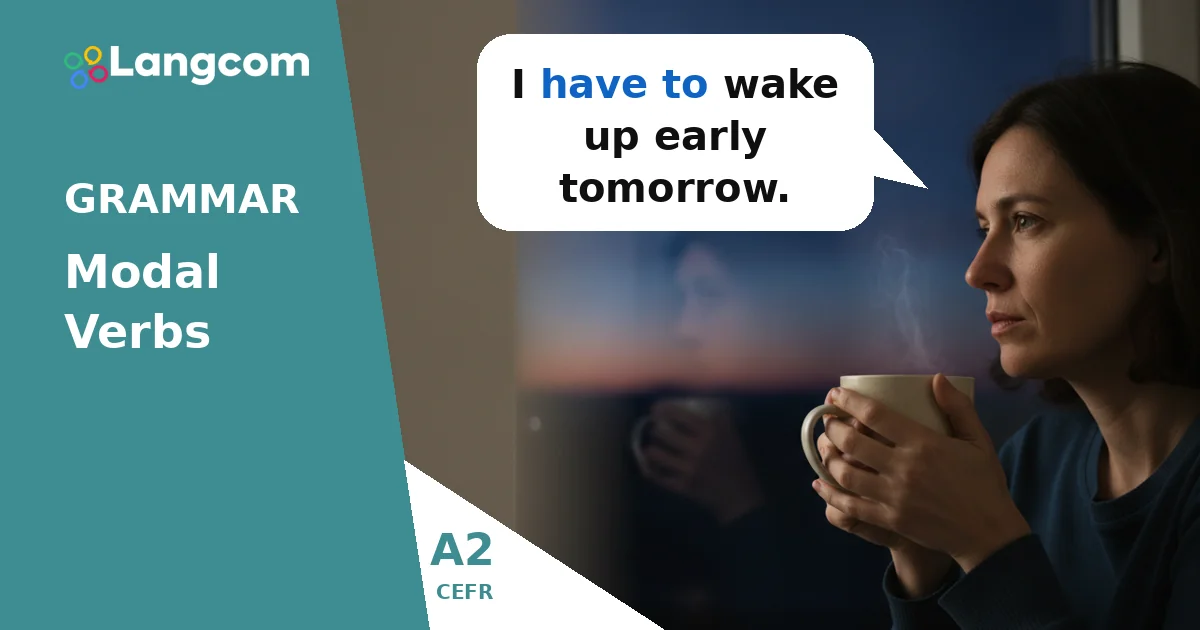

What Does Have to Mean?
Have to shows that something is necessary.
- It means you must do something because of a rule, a law, or a situation.
- The obligation often comes from outside you, not from your personal feeling.
- Example: Students have to wear a uniform at this school. (This is a school rule.)
- Example: I have to go to the bank. It closes soon. (The situation makes it necessary.)
🎓 Learn English with the Blended method
Small groups · 24/7 AI Tutor · Cambridge preparation
Plans from $39 $79 per month
How Do We Use Have to?
We use have to with all subjects.
- Remember to change have to has for he, she, and it.
- The verb after have to is always in the base form (infinitive without to).
- I / You / We / They + have to + verb
- He / She / It + has to + verb
What Does Don’t Have to Mean?
Don’t have to shows that something is NOT necessary.
- It means you are free to do it or not do it. There is no obligation.
- Example: You don’t have to pay for this. It’s free. (Paying is not necessary.)
- Example: She doesn’t have to work on Sundays. (She has no obligation to work on Sundays.)
How Do We Use Don’t Have to?
We use do not have to (or don’t have to) for I, you, we, they.
- We use does not have to (or doesn’t have to) for he, she, it.
- The verb after have to is always in the base form.
- I / You / We / They + don’t have to + verb
- He / She / It + doesn’t have to + verb
How Do We Ask Questions with Have to?
To ask a question, we use do or does at the beginning of the sentence.
- Remember to use have to (not has to) for all subjects in questions.
- Do + I / you / we / they + have to + verb?
- Does + he / she / it + have to + verb?
- Example: Do you have to wear a uniform?
- Example: Does he have to study for the exam?
| Subject | Positive | Negative | Question |
|---|---|---|---|
| I / You / We / They | have to work | don’t have to work | Do I have to work? |
| He / She / It | has to work | doesn’t have to work | Does he have to work? |
Examples
- I have to wake up early tomorrow.
- She has to finish her homework before dinner.
- We don’t have to work on holidays.
- He doesn’t have to cook tonight; we’re eating out.
- Do you have to travel for your job?
- Does she have to learn English for her new role?
- They have to follow the safety rules.
- You don’t have to apologize; it’s okay.
Practice
💬 Need personalized guidance?
As an Authorized Cambridge Preparation Centre, we can guide you to the right course and certification. Chat with our advisors today.
Chat with an Advisor on WhatsAppCommon mistakes for Spanish speakers
- Using must not instead of don’t have to: Many Spanish speakers confuse “no es necesario” with “no está permitido.”
- Incorrect: You must not work today. (This means it’s forbidden to work.)
- Correct: You don’t have to work today. (This means working is not necessary.)
- Forgetting to: Remember that have is followed by to.
- Incorrect: I have go now.
- Correct: I have to go now.
- Incorrect conjugation for he/she/it: Using have to instead of has to in positive sentences, or don’t have to instead of doesn’t have to.
- Incorrect: She have to study.
- Correct: She has to study.
- Incorrect: He don’t have to wait.
- Correct: He doesn’t have to wait.
- Using has to in questions: Questions with do/does always use have to.
- Incorrect: Does she has to work?
- Correct: Does she have to work?
Frequently asked questions
What is the main difference between have to and must?
For A2, remember that have to often describes obligations from external rules or situations (e.g., I have to wear a uniform). Must can be used for strong personal obligations (e.g., I must call my mother) or for strong recommendations.
Can I use got to instead of have to?
Yes, in informal spoken English, got to (often shortened to gotta) is common. For example, I’ve got to go now means the same as I have to go now. However, have to is better for formal writing.
Does don’t have to mean the same as must not?
No, they are very different! Don’t have to means “it is not necessary” (e.g., You don’t have to pay). Must not means “it is forbidden” or “it is not allowed” (e.g., You must not smoke here).



0 Comments