
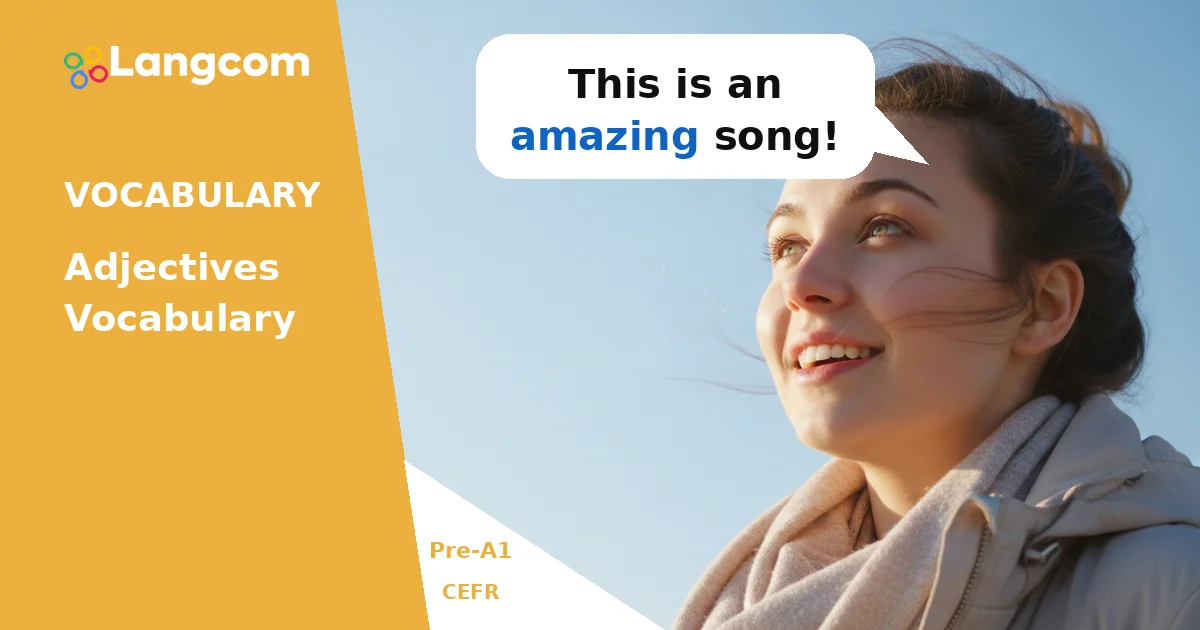

What Are Adjectives?
Adjectives are special words. They describe nouns. Nouns are people, places, or things.
Adjectives tell you more about a noun. For example:
- a big dog (big describes the dog)
- a happy girl (happy describes the girl)
- a red car (red describes the car)
🎓 Learn English with the Blended method
Small groups · 24/7 AI Tutor · Cambridge preparation
Plans from $39 $79 per month
How to Describe Good Things?
Sometimes, things are very good. We use these adjectives to say something is positive.
- Amazing: This means very, very good. It is surprising and wonderful.
- The view is amazing!
- Awesome: This also means very good or impressive. It is similar to amazing.
- That concert was awesome.
- Interesting: This means something keeps your attention. It is not boring.
- This book is very interesting.
How to Describe Bad Things?
Sometimes, things are not good. We use these adjectives to say something is negative.
- Boring: This means something is not interesting. It makes you feel tired.
- The film was boring.
- Horrible: This means very bad or unpleasant. It makes you feel bad.
- The food was horrible.
- Terrible: This also means very bad. It is similar to horrible.
- The weather is terrible today.
Where Do Adjectives Go in a Sentence?
Adjectives usually go in two places:
- Before a noun: The adjective comes before the word it describes.
- It’s an interesting movie. (NOT It’s a movie interesting.)
- She has a horrible idea.
- After the verb ‘to be’ (am, is, are): The adjective describes the subject of the sentence.
- The movie is interesting.
- The food was terrible.
| Adjective | Meaning (Simple) |
|---|---|
| Amazing | Very, very good; wonderful |
| Awesome | Very good; impressive |
| Interesting | Not boring; keeps your attention |
| Boring | Not interesting; makes you feel tired |
| Horrible | Very bad; unpleasant |
| Terrible | Very bad; awful |
Examples
- This is an amazing song!
- The new park is awesome.
- I read an interesting article.
- That TV show is very boring.
- What a horrible smell!
- My day was terrible.
- She is an amazing teacher.
- The party was awesome last night.
- I find history very interesting.
- This game is boring.
- The traffic was horrible.
- I had a terrible dream.
Practice
💬 Need personalized guidance?
As an Authorized Cambridge Preparation Centre, we can guide you to the right course and certification. Chat with our advisors today.
Chat with an Advisor on WhatsAppCommon mistakes for Spanish speakers
Spanish speakers sometimes put adjectives after the noun, like in Spanish. But in English, adjectives usually go BEFORE the noun.
- Incorrect: I have a car red.
- Correct: I have a red car.
- Incorrect: It was a film boring.
- Correct: It was a boring film.
Also, remember that adjectives do not change for plural nouns. They stay the same.
- Incorrect: Two amazingS films.
- Correct: Two amazing films.
Frequently asked questions
What is an adjective?
An adjective is a word that describes a noun (a person, place, or thing). For example, happy in a happy child is an adjective.
Where do adjectives go in a sentence?
Adjectives usually go before the noun they describe (e.g., a big house) or after the verb to be (e.g., The house is big.).
What is the difference between amazing and awesome?
Amazing and awesome are very similar! They both mean ‘very, very good’ or ‘impressive’. You can use them to describe things you really like.
Do adjectives change for plural nouns?
No, adjectives in English do not change for plural nouns. For example, you say one amazing film and two amazing films. The adjective amazing stays the same.


0 Comments