
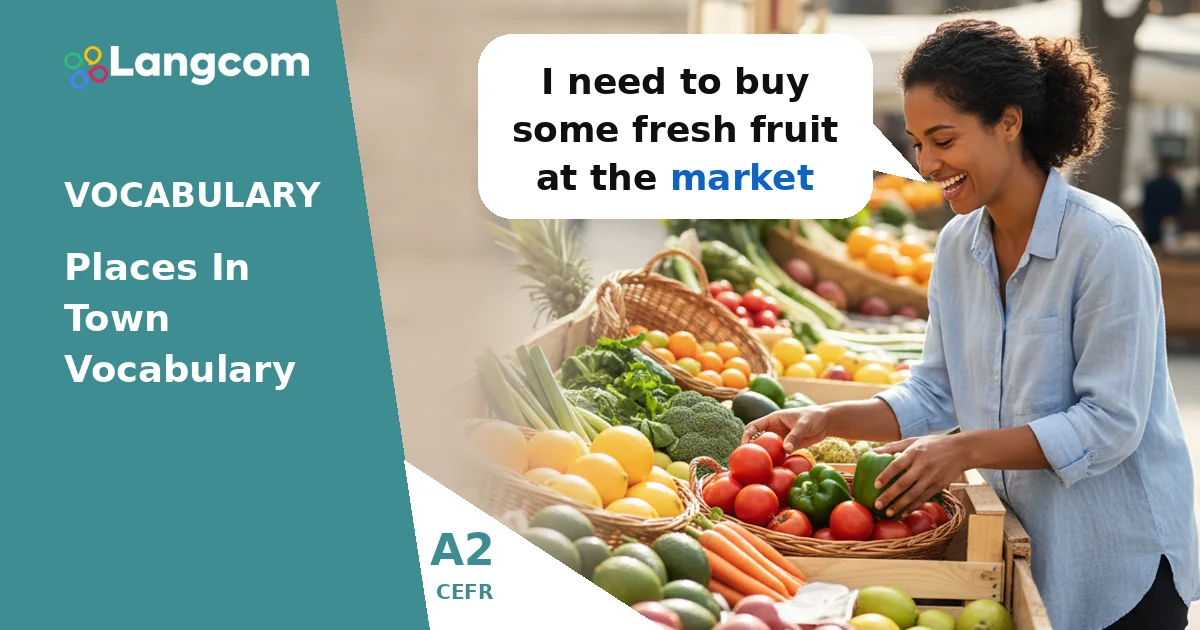

Learning vocabulary for places in town helps you talk about where you go and what you do. Knowing these words is very useful for daily life and for the A2 Key English exam. You can describe your city, ask for directions, or talk about your routine. Words like supermarket, park, and chemist are important for many situations. This lesson will teach you common places and how to use them in sentences. You will learn to identify different shops and public buildings, making your English communication clearer and more confident when talking about your local area.
What are common places in town?
Every town has many different places. We go to these places for different reasons. Some places are for shopping, some are for fun, and some are for important services.
- A supermarket is a big shop where you buy food and other things for your home.
- A park is an open green area where people can relax, play, or walk.
- A school is a place where children and young people learn.
- A hospital is where sick or injured people go for medical help.
✍️ Not sure which level you are?
Take our free placement test and get personalized feedback from certified Cambridge examiners.
Take our FREE Placement TestWhere do you go to buy things?
There are many types of shops in a town. Each shop sells different things.
- A bookshop sells books. You can buy novels, textbooks, and magazines here.
- A chemist (or pharmacy) sells medicines and health products.
- A market is a place, often outside, where people sell fresh food like fruit, vegetables, and meat.
- A department store is a very large shop that sells many different types of products, like clothes, electronics, and home goods, usually on different floors.
- A sports shop sells clothes, shoes, and equipment for sports.
- A bakery sells bread, cakes, and pastries.
- A clothes shop sells clothes.
Where do you go for services?
Some places offer important services for people in the town.
- A bank is where you can keep your money, take out money, or pay bills.
- A post office is where you send letters and packages. You can also buy stamps there.
- A library is a place where you can borrow books for free. You can also read newspapers or use computers there.
- A police station is where police officers work. You go there if you need help or want to report a crime.
Places for fun and travel
Towns also have places for entertainment and for travelling.
- A cinema is where you go to watch films.
- A museum is a place where you can see old or interesting objects, like art or historical items.
- A restaurant is where you go to eat a meal.
- A cafe is where you can buy coffee, tea, and light snacks.
- A bus stop is where you wait for a bus.
- A train station is where you can catch a train to another town or city.
| Place | What you do there |
|---|---|
| Supermarket | Buy food and household items |
| Bookshop | Buy books |
| Chemist / Pharmacy | Buy medicines and health products |
| Bank | Manage money, take out cash |
| Library | Borrow books, read, study |
| Cinema | Watch films |
| Park | Relax, play, walk |
| Restaurant / Cafe | Eat food, drink coffee |
Examples
- I need to buy some fresh fruit at the market today.
- Let's meet at the cafe for coffee at 3 PM.
- My favourite bookshop is near the park.
- You can find new trainers at the sports shop.
- I borrowed a book from the library yesterday.
- The nearest chemist is open until 7 PM.
- We watched a great film at the cinema last night.
- I need to send this letter at the post office.
Practice
Ready to earn your certificate?
Langcom prepares students for Cambridge, IELTS, TOEFL, DELE, SIELE and Michigan exams.
Get started with LangcomCommon mistakes for Spanish speakers
Spanish speakers sometimes confuse similar-sounding words or direct translations:
- Library vs. Bookshop: In Spanish, 'librería' means bookshop (where you buy books). The English word library means 'biblioteca' (where you borrow books).
Incorrect: I bought a book at the library.
Correct: I bought a book at the bookshop.
Correct: I borrowed a book from the library. - Chemist vs. Pharmacy: Both chemist and pharmacy are correct in English for 'farmacia'. Chemist is more common in British English, and pharmacy is common in American English, but both are understood.
Frequently asked questions
What is the difference between a 'market' and a 'supermarket'?
A market is often an outdoor place where different sellers have stalls, usually for fresh food. A supermarket is a large indoor shop that sells a wide variety of food and household products.
Can I use 'chemist' and 'pharmacy' interchangeably?
Yes, you can use chemist and pharmacy to mean the same thing. They both refer to a place where you can buy medicines. Chemist is more common in British English.
Why is this vocabulary important for the A2 Key exam?
For the A2 Key exam, you need to understand and use vocabulary related to daily life. You might need to describe your town, talk about your hobbies, or ask for directions in the Speaking or Writing parts. Knowing places like post office, bank, or cinema is very useful for these tasks.
What is a 'department store'?
A department store is a very big shop that sells many different types of goods, often on different floors or in different sections. For example, it might have a clothes department, a home goods department, and a cosmetics department.


0 Comments