

When Do We Use ‘Some’?
Some is a quantifier we use to refer to an indefinite quantity or number. It can be used with both plural countable nouns and uncountable nouns.
- Positive Sentences: Wir verwenden some in affirmative (positive) statements.
- Offers and Requests: We also use some in questions when we are offering something or making a request, and we expect a ‘yes’ answer.
Denken Sie daran, dass some implies a quantity that is more than zero but not specified.
✍️ Du bist dir nicht sicher, auf welchem Niveau du bist?
Machen Sie unseren kostenlosen Einstufungstest und erhalten Sie individuelles Feedback von zertifizierten Cambridge-Prüfern.
Machen Sie unseren KOSTENLOSEN EinstufungstestWhen Do We Use 'Any'?
Any is another quantifier that refers to an indefinite quantity or number. It is also used with both plural countable nouns and uncountable nouns.
- Verneinende Sätze: Wir verwenden any in negative statements, usually after not.
- General Questions: Wir verwenden any in most questions when we are not sure if the answer will be 'yes' or 'no'.
- Meaning 'It doesn't matter which': Any can also mean 'all of them' or 'it doesn't matter which one' in positive sentences.
This usage of any is common when giving choices or general permissions.
When Do We Use 'No'?
No is a determiner that means 'not any' or 'zero'. It is used with a positive verb to create a negative meaning for the sentence. Like some und any, it can be used with both plural countable nouns and uncountable nouns.
- Affirmative Verb, Negative Meaning: When you use no, the verb in the sentence must be positive. This is crucial to avoid a double negative, which is incorrect in standard English.
No is often used for emphasis or to give a direct, strong negative answer.
Using 'Some', 'Any', and 'No' with Compound Words
These quantifiers also form compound words, which follow similar rules for usage:
- Compounds with some-: Somebody, someone, something, somewhere. These are generally used in positive sentences, offers, and requests.
- Compounds with any-: Anybody, anyone, anything, anywhere. These are typically used in negative sentences and questions.
- Compounds with no-: Nobody, no one, nothing, nowhere. These are used with a positive verb to give a negative meaning.
Understanding these compounds helps you talk about people, things, and places without being specific.
| Quantifier | Positive Sentences | Negative Sentences | Questions | Noun Types |
|---|---|---|---|---|
| Some | Yes (general, offers, requests) | No | Yes (offers, requests expecting 'yes') | Plural Countable, Uncountable |
| Any | Yes ('it doesn't matter which') | Yes (after not) | Yes (general questions) | Plural Countable, Uncountable |
| No | Yes (with positive verb for negative meaning) | No (avoids double negative) | No | Plural Countable, Uncountable |
Beispiele
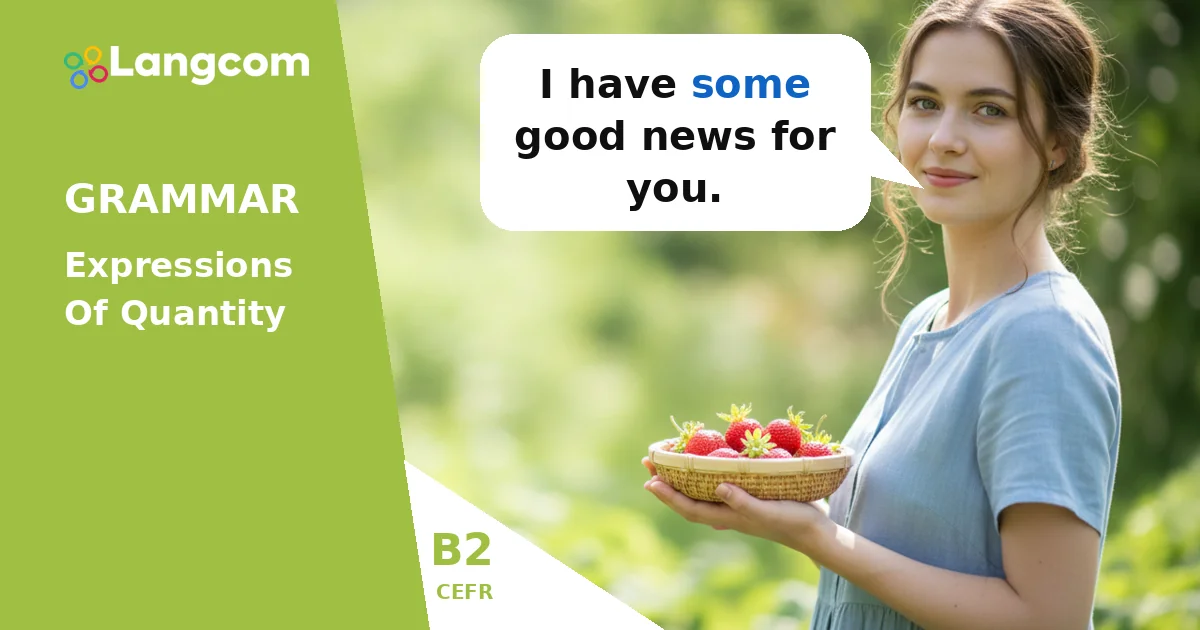
- I have some good news for you.
- Would you like some coffee?
- Can I have some water, please?
- I don't have any money left.
- Do you have any questions?
- You can choose any book you like.
- There is no milk in the fridge.
- No student failed the exam.
- Somebody called you earlier.
- Is there anything I can do to help?
- I saw nobody at the party.
Übung
Bist du bereit, dein Zertifikat zu erwerben?
Der Kurs Langcom bereitet die Teilnehmer auf die Prüfungen von Cambridge, IELTS, TOEFL, DELE, SIELE und Michigan vor.
Erste Schritte mit LangcomHäufige Fehler bei Spanischsprechern
Spanish speakers often make mistakes with no und any due to differences in negation rules between English and Spanish.
- Double Negatives: In Spanish, it's common to use multiple negative words in one sentence (e.g., No tengo nada). In English, this is incorrect. You must use only one negative element.
- Falsch: I don't have no money.
- Richtig: I don't have any money. (Uses not + any)
- Richtig: I have no money. (Uses no with a positive verb)
- Verwendung von any in positive sentences: Unless any means 'it doesn't matter which', it should not be used in positive statements.
- Falsch: I have any friends.
- Richtig: I have some friends.
Häufig gestellte Fragen
What is the main difference between 'some' and 'any'?
The main difference is that some is generally used in positive statements, offers, and requests (when you expect a 'yes' answer). Any is typically used in negative statements and most questions. However, any can also be used in positive sentences to mean 'it doesn't matter which'.
Can I use 'some' in questions?
Ja, du kannst some in questions, but usually only when you are making an offer (Would you like some tea?) or a request (Could I have some water?). In these cases, you usually expect a 'yes' answer.
When should I use 'no' instead of 'not any'?
Du verwendest no with a positive verb to give a negative meaning, for example, I have no time. Du verwendest not any with a negative verb, for example, I don't have any time. Both are correct and mean the same thing, but no can sometimes sound more direct or emphatic.
How is this grammar point relevant for the B2 First (FCE) exam?
Understanding some, any, und no is crucial for the B2 First exam, especially in the Use of English paper. You might encounter questions in Part 1 (Multiple-choice cloze) or Part 2 (Open cloze) where you need to choose the correct quantifier to complete a sentence accurately, demonstrating your grasp of nuances in meaning and grammatical context.



0 Kommentare