

What Are Multi-Word Verbs?
Multi-word verbs are verbs that consist of a main verb and one or two particles. These particles are usually prepositions (like in, on, at) or adverbs (like up, down, away).
Sometimes, the meaning of a multi-word verb is clear from its parts, like sit down. However, often the meaning is idiomatic, which means it is different from the individual words. For example, give up means ‘stop trying’, not literally ‘give something upwards’.
- Phrasal verbs: verb + adverb particle (z. B., turn off).
- Prepositional verbs: verb + preposition particle (z. B., look after).
- Phrasal-prepositional verbs: verb + adverb particle + preposition particle (z. B., look forward to).
Many people use the term ‘phrasal verb’ to refer to all three types of multi-word verbs.
✍️ Du bist dir nicht sicher, auf welchem Niveau du bist?
Machen Sie unseren kostenlosen Einstufungstest und erhalten Sie individuelles Feedback von zertifizierten Cambridge-Prüfern.
Machen Sie unseren KOSTENLOSEN EinstufungstestTransitive or Intransitive: Do They Need an Object?
Understanding if a multi-word verb is transitive or intransitive is important for correct usage.
- Transitive multi-word verbs need an object. The object receives the action of the verb. For example, in I picked up the book, 'the book' is the object.
- Intransitive multi-word verbs do not need an object. The action is complete without anything receiving it. For example, The plane took off. There is no object after took off.
Many multi-word verbs can be both transitive and intransitive, depending on the context. For instance, wake up can be intransitive (I woke up early) or transitive (I woke my brother up).
Understanding Object Placement in Transitive Multi-Word Verbs
For transitive multi-word verbs, the object's position can change. This is a key point for B2 learners.
- Separable multi-word verbs: The object can go between the verb and the particle, or after the particle. For example, turn off the light oder turn the light off.
- Inseparable multi-word verbs: The object must always come after the particle. For example, look after my cat. You cannot say look my cat after.
There is a special rule for pronouns:
- If the object is a pronoun (e.g., it, them, him), it almost always goes between the verb and the particle for separable multi-word verbs. For example, turn it off, nicht turn off it.
Types of Multi-Word Verbs and Their Structures
Let's look at the main types of multi-word verbs based on their structure and how they handle objects.
- Intransitive Multi-Word Verbs (Verb + Particle)
- These verbs do not take an object.
- Structure: verb + particle
- Examples: wake up, go away, fall over, stay up.
- I usually wake up at 7 AM.
- Separable Multi-Word Verbs (Verb + Particle + Object OR Verb + Object + Particle)
- These verbs take an object, and the particle can be separated from the verb by the object.
- Structure: verb + object + particle ODER verb + particle + object
- Pronoun rule: If the object is a pronoun, it must go between the verb and the particle.
- Examples: throw away, pick up, try out.
- Please throw away those old papers.
- Please throw them away. (Not: throw away them)
- Inseparable Multi-Word Verbs (Verb + Particle + Object)
- These verbs take an object, but the particle cannot be separated from the verb. The object always comes after the particle.
- Structure: verb + particle + object
- Examples: look into, focus on, believe in, look after.
- The police are looking into the case.
- Who will look after your dog?
- Three-Part Multi-Word Verbs (Verb + Particle 1 + Particle 2 + Object)
- These verbs always take an object, and the object always comes after both particles.
- Structure: verb + particle + particle + object
- Examples: come up with, look down on, run out of, get away with.
- She came up with a great idea.
- We've run out of milk.
Why Are Multi-Word Verbs Important for B2 English?
At the B2 level, you are expected to understand and use a wider range of vocabulary, including more complex structures like multi-word verbs.
- Naturalness: Using multi-word verbs makes your English sound more natural and fluent, closer to how native speakers communicate.
- Comprehension: Many everyday conversations, films, and books use multi-word verbs frequently. Understanding them is key to full comprehension.
- Expressing Nuance: They often allow you to express ideas more concisely or with a specific nuance that a single verb might not capture. For example, put off (postpone) is more common than postpone in casual speech.
| Typ | Aufbau | Object Placement | Beispiel |
|---|---|---|---|
| Intransitive | Verb + Particle | No object | The alarm went off. |
| Separable | Verb + Particle + Object ODER Verb + Object + Particle | Object can go in the middle or after. Pronouns always in the middle. | Turn off the light. / Turn the light off. / Turn it off. |
| Inseparable | Verb + Particle + Object | Object always after the particle. | Look after your children. |
| Three-Part | Verb + Particle 1 + Particle 2 + Object | Object always after both particles. | I look up to my mentor. |
Beispiele
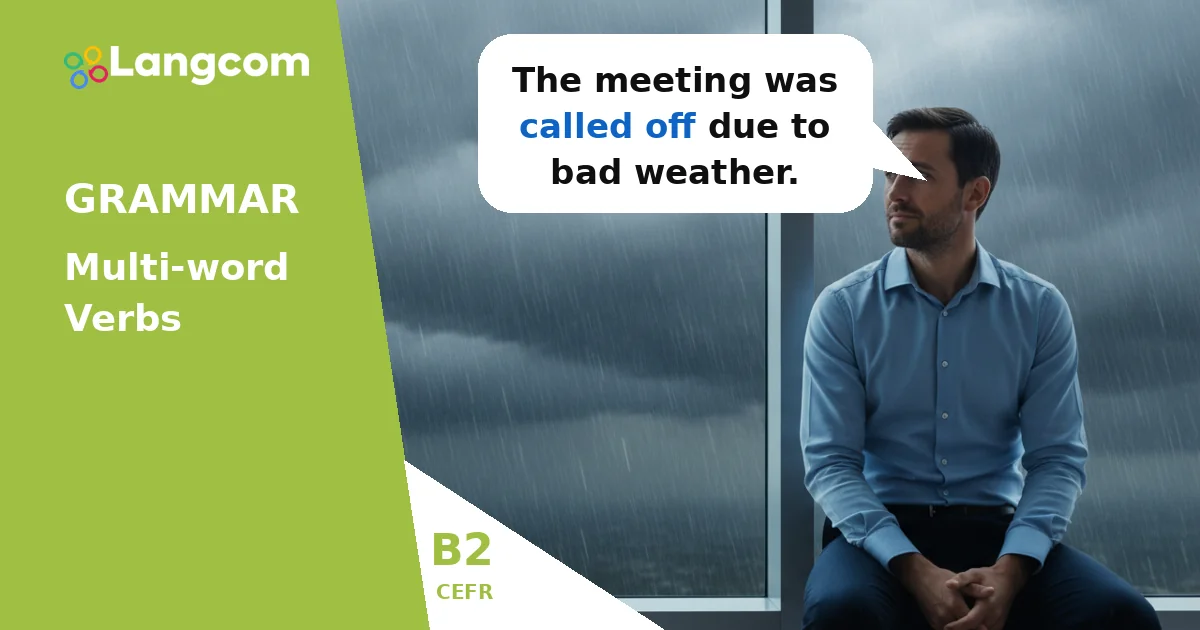
- The meeting was called off due to bad weather.
- She always looks after her younger sister.
- I need to look up this word in the dictionary.
- Don't give up on your dreams!
- He tried on the new shoes before buying them.
- We ran out of coffee this morning.
- Please fill out this form.
- Can you pick me up from the airport?
Übung
Bist du bereit, dein Zertifikat zu erwerben?
Der Kurs Langcom bereitet die Teilnehmer auf die Prüfungen von Cambridge, IELTS, TOEFL, DELE, SIELE und Michigan vor.
Erste Schritte mit LangcomHäufige Fehler bei Spanischsprechern
Spanish speakers often make specific mistakes with multi-word verbs:
- Literal Translation: Trying to translate multi-word verbs word-for-word from Spanish can lead to incorrect meanings. For example, ponerse (to put on clothes) is not put on in the sense of 'to trick someone'.
- Incorrect Object Placement with Pronouns: A very common error is placing a pronoun after the particle in separable multi-word verbs.
- Falsch: I picked up it.
- Richtig: I picked it up.
- Confusing Transitive and Intransitive: Using an object with an intransitive multi-word verb, or forgetting an object for a transitive one. For example, go away is intransitive, so you cannot say go him away.
- Assuming Separability: Treating all multi-word verbs as separable. Remember, many are inseparable, like look into. You must say look into the problem, nicht look the problem into.
Häufig gestellte Fragen
What is the difference between a phrasal verb and a multi-word verb?
The term 'multi-word verb' is a broader category that includes phrasal verbs, prepositional verbs, and phrasal-prepositional verbs. 'Phrasal verb' is often used informally to refer to all of them, but technically, a phrasal verb specifically combines a verb with an adverb particle, like turn off.
How can I learn so many multi-word verbs?
Learning multi-word verbs takes time and practice. Try to learn them in context, not just as isolated words. Group them by topic (e.g., travel, relationships) or by common particles (e.g., verbs with up). Use a good dictionary to check their meanings, transitivity, and object placement. Regular exposure through reading and listening is also very helpful.
Do multi-word verbs appear in B2 English exams?
Yes, multi-word verbs are very common in B2 English exams like Cambridge First (FCE) or IELTS. You might find them in reading comprehension, listening tasks, and especially in the 'Use of English' paper, where you need to choose the correct multi-word verb to complete a sentence or transform words. Using them correctly in your writing and speaking will also boost your score.
Are multi-word verbs formal or informal?
Multi-word verbs can be both formal and informal. Many are very common in everyday, informal conversation (e.g., hang out, chill out). However, many others are perfectly appropriate in more formal contexts, such as carry out (perform), point out (indicate), or set up (establish). It depends on the specific verb and its meaning.


0 Kommentare