

Why Are There So Many Ways to Talk About the Future?
Unlike some languages, English does not have a single ‘future tense’. Instead, we use various verb forms to express different types of future events.
The choice of form depends on whether you are talking about a spontaneous decision, a plan, a fixed arrangement, a prediction, or an event that will be in progress or completed at a future time.
✍️ Du bist dir nicht sicher, auf welchem Niveau du bist?
Machen Sie unseren kostenlosen Einstufungstest und erhalten Sie individuelles Feedback von zertifizierten Cambridge-Prüfern.
Machen Sie unseren KOSTENLOSEN EinstufungstestWhen Do We Use 'Will' for the Future?
Wir verwenden will + base verb for several situations:
- Spontaneous Decisions: For decisions made at the moment of speaking. For example: I'm thirsty. I'll get a glass of water.
- Predictions (General Belief): When we predict something based on our opinion or general knowledge. For example: I think it will rain tomorrow.
- Offers and Promises: To make an offer or a promise. For example: I'll help you with your homework. oder I promise I won't be late.
- Future Facts: For events that are certain to happen. For example: The sun will rise at 6 AM tomorrow.
- First Conditional: In the main clause of a first conditional sentence. For example: If it rains, we'll stay home.
When Do We Use 'Be Going To' for the Future?
Wir verwenden be going to + base verb for:
- Plans and Intentions: For plans or intentions that have already been decided before the moment of speaking. For example: We are going to visit our grandparents next weekend.
- Predictions (Based on Evidence): When we predict something because there is clear evidence in the present. For example: Look at those dark clouds! It's going to storm.
How Do We Use Present Tenses for Future Events?
Both the present continuous and present simple can refer to the future:
- Present Continuous (be + -ing): For definite future arrangements, often with a specific time or date. These are usually personal plans. For example: I'm meeting Sarah for lunch tomorrow.
- Present Simple (base verb / -s): For events based on a timetable, schedule, or fixed programme. These are usually impersonal events. For example: The train leaves at 7:00 AM. oder The concert starts at 8 PM.
What About the Future Continuous?
Die future continuous (will be + -ing) describes an action that will be in progress at a specific time in the future.
- It emphasizes the duration of the action. For example: This time next week, I'll be lying on a beach.
- It can also be used to ask politely about someone's plans. For example: Will you be using the car tomorrow?
When Do We Use the Future Perfect Simple?
Die future perfect simple (will have + past participle) describes an action that will be completed by a certain time in the future.
- It focuses on the completion of the action before a future deadline. For example: By next year, I will have finished my degree.
- We often use 'by' or 'by the time' with this tense. For example: By 5 PM, they will have arrived.
Other Ways to Talk About the Future
There are a few other useful expressions for the future:
- Be due to: For something scheduled or expected to happen. For example: The new library is due to open next month.
- Be about to: For something that will happen very soon. For example: Shh! The movie is about to start.
| Form | Verwendung | Beispiel |
|---|---|---|
| Will + base verb | Spontaneous decisions, general predictions, offers, promises, future facts | I'll help you. |
| Be going to + base verb | Pre-decided plans/intentions, predictions based on evidence | She's going to study abroad. |
| Present Continuous | Fixed personal arrangements | We're meeting at 7 PM. |
| Present Simple | Timetables, schedules, fixed programs | The shop opens at 9 AM. |
| Will be + -ing | Action in progress at a future time | This time tomorrow, I'll be flying. |
| Will have + past participle | Action completed by a future time | By June, I will have saved enough. |
| Be due to + base verb | Scheduled or expected event | The concert is due to start. |
| Be about to + base verb | Something happening very soon | They are about to announce the winner. |
Beispiele
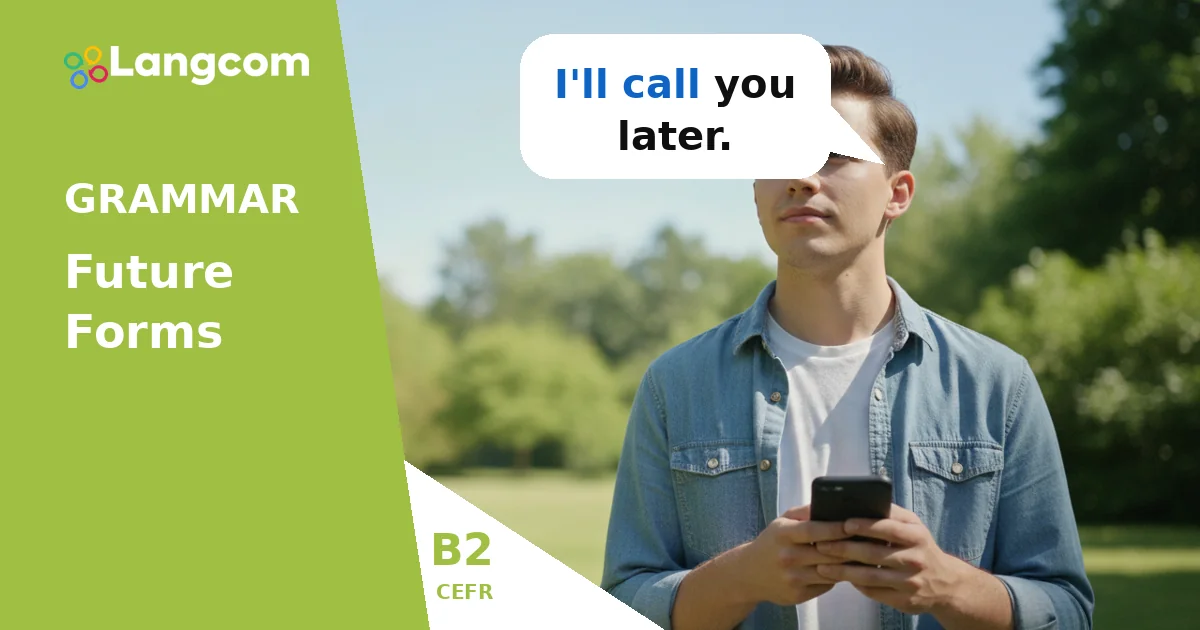
- I'll call you later.
- They are going to build a new bridge.
- We're having dinner with friends on Saturday.
- The flight arrives at 10:30 PM.
- At midnight, I'll be sleeping soundly.
- By the end of the month, she will have saved enough money for the trip.
- The train is due to depart in five minutes.
- He is about to leave for work.
Übung
Bist du bereit, dein Zertifikat zu erwerben?
Der Kurs Langcom bereitet die Teilnehmer auf die Prüfungen von Cambridge, IELTS, TOEFL, DELE, SIELE und Michigan vor.
Erste Schritte mit LangcomHäufige Fehler bei Spanischsprechern
Spanish speakers often make these common mistakes with English future forms:
- Verwendung von will in time clauses: In English, we use the present simple, nicht will, after words like when, as soon as, until, before, after.
Falsch: I will call you when I will arrive.
Richtig: I will call you when I arrive. - Verwirrend will und going to for plans: Remember will is for spontaneous decisions, while going to is for pre-decided plans.
Incorrect (for a pre-planned vacation): I will go on holiday next month.
Richtig: I am going to go on holiday next month. - Verwendung von will for fixed arrangements: For definite, diary-like arrangements, use the present continuous.
Falsch: I will meet my boss at 9 AM tomorrow.
Richtig: I am meeting my boss at 9 AM tomorrow.
Häufig gestellte Fragen
What is the main difference between 'will' and 'be going to'?
The main difference is about when the decision was made. We use will for spontaneous decisions made at the moment of speaking, or for general predictions. We use be going to for plans or intentions that were decided before the moment of speaking, or for predictions based on present evidence.
Can I use the present continuous and present simple interchangeably for the future?
No, they have different uses. The present continuous is for personal, fixed arrangements (like a meeting in your diary). The present simple is for impersonal, scheduled events (like a train timetable or a concert start time).
How can understanding future forms help me in the B2 First (FCE) exam?
Mastering future forms is essential for the B2 First exam. In the Speaking test, you'll need to discuss future plans and predictions accurately. In the Writing test, especially for essays or reports, you'll use various future forms to express plans, predictions, and scheduled events clearly and precisely.
When should I use the future perfect simple instead of other future forms?
Use the future perfect simple (will have + past participle) when you want to emphasize that an action will be completed *before* a specific point in the future. For example, By 2030, humans will have landed on Mars focuses on the completion of the landing before that year.



0 Kommentare