

What Are -ed and -ing Adjectives?
Many adjectives in English are formed from verbs by adding -ed oder -ing. These are called participles when they function as adjectives.
- Adjectives ending in -ed, wie bored oder interested, describe a feeling or an emotion. They tell us how someone feels.
- Adjectives ending in -ing, wie boring oder interesting, describe the thing or person that causes the feeling. They tell us about the quality of something.
✍️ Du bist dir nicht sicher, auf welchem Niveau du bist?
Machen Sie unseren kostenlosen Einstufungstest und erhalten Sie individuelles Feedback von zertifizierten Cambridge-Prüfern.
Machen Sie unseren KOSTENLOSEN EinstufungstestWhen Do We Use -ed Adjectives?
Wir verwenden -ed adjectives to talk about how a person or an animal feels. They describe the emotional state of a subject.
- I was surprised by the news. (I felt surprise.)
- She felt very tired after the long journey. (She experienced tiredness.)
- The children were excited about their holiday. (They had a feeling of excitement.)
Common -ed adjectives include bored, interested, excited, tired, surprised, annoyed, confused, disappointed, embarrassed, frightened, frustrated, shocked, und worried.
When Do We Use -ing Adjectives?
Wir verwenden -ing adjectives to describe the person, thing, or situation that causes a particular feeling. They describe a characteristic or quality.
- The news was surprising. (The news caused surprise.)
- The journey was very tiring. (The journey caused tiredness.)
- Their holiday plans sound exciting. (The plans cause excitement.)
Common -ing adjectives include boring, interesting, exciting, tiring, surprising, annoying, confusing, disappointing, embarrassing, frightening, frustrating, shocking, und worrying.
Key Differences and Examples
It is important to remember the core difference: -ed for the person experiencing the feeling, -ing for the thing causing it.
- The lecture was boring. I felt bored during the lecture.
- She is an interesting person. I am very interested in her stories.
- That film was really frightening. We were all frightened by the monster.
- My job is often frustrating. I get frustrated when things go wrong.
| Adjektiv | Describes... |
|---|---|
| Bored | How a person feels |
| Boring | What causes the feeling |
| Interested | How a person feels |
| Interesting | What causes the feeling |
| Excited | How a person feels |
| Exciting | What causes the feeling |
| Tired | How a person feels |
| Tiring | What causes the feeling |
Beispiele
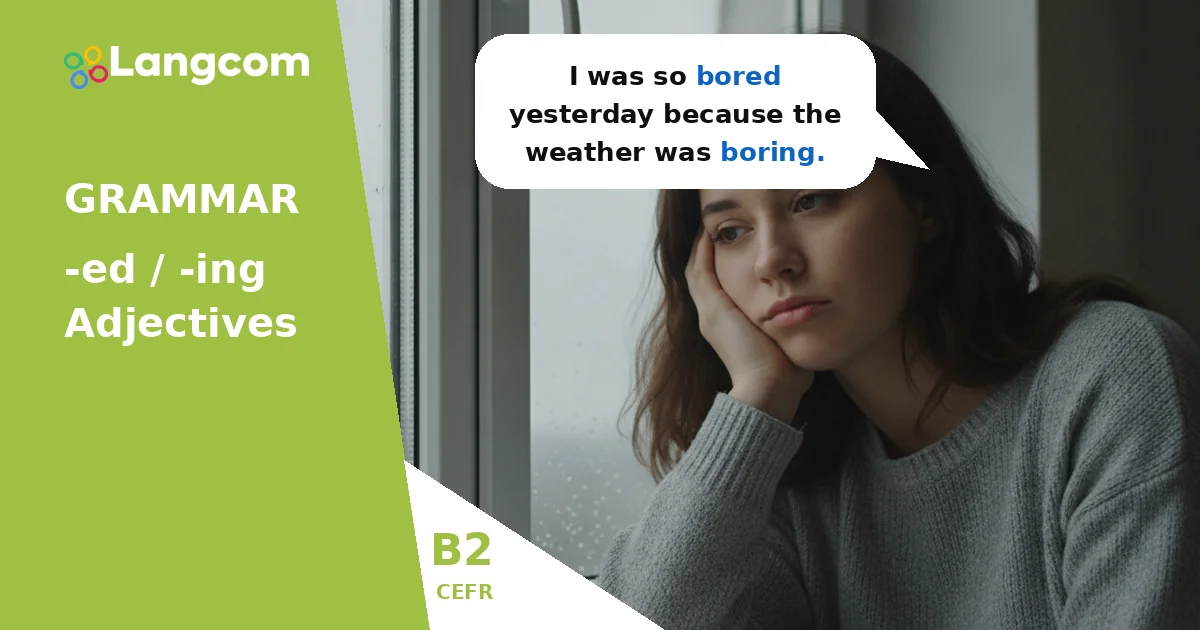
- I was so bored yesterday because the weather was boring.
- The children were excited to see the exciting circus performance.
- She found the book very interesting, so she was interested in reading more.
- His constant complaining is annoying; I'm very annoyed by it.
- The news about the accident was shocking, and everyone felt shocked.
- It was an embarrassing moment for him; he felt so embarrassed.
Übung
Bist du bereit, dein Zertifikat zu erwerben?
Der Kurs Langcom bereitet die Teilnehmer auf die Prüfungen von Cambridge, IELTS, TOEFL, DELE, SIELE und Michigan vor.
Erste Schritte mit LangcomHäufige Fehler bei Spanischsprechern
A very common mistake for Spanish speakers is to confuse I am boring mit I am bored. In Spanish, you might say 'Estoy aburrido/a' to mean you feel bored. However, in English:
- I am boring. (Incorrect if you mean you feel bored) This means you cause other people to feel bored. You are not an interesting person.
- I am bored. (Correct) This means you feel uninterested or tired of something.
Always remember: if you are describing your feeling, verwende -ed. If you are describing a quality of yourself or something else that causes a feeling in others, use -ing.
Häufig gestellte Fragen
Can -ed adjectives describe things?
Generally, -ed adjectives describe how a person or animal feels. While some past participles can describe the state of an object (e.g., a broken window, a finished project), these are not describing emotions. For adjectives describing emotional impact, -ed is for the experiencer, -ing for the cause.
Are there any verbs that don't form both -ed and -ing adjectives?
Yes, not every verb can form both types of adjectives in this emotional sense. For example, you wouldn't typically say I am eating as an adjective for a feeling, nor an eaten meal to describe something causing a feeling. The rule primarily applies to verbs related to emotions and states, like bore, interest, excite, surprise, usw.
How are -ed and -ing adjectives tested in the B2 First (FCE) exam?
These adjectives are frequently tested in the B2 First exam, particularly in the Use of English Part 3 (Word Formation). You might be given a base verb like 'bore' and need to decide whether to form bored oder boring based on the context of the sentence. They can also appear in Part 2 (Open Cloze) oder Part 4 (Key Word Transformation).


0 Kommentare