
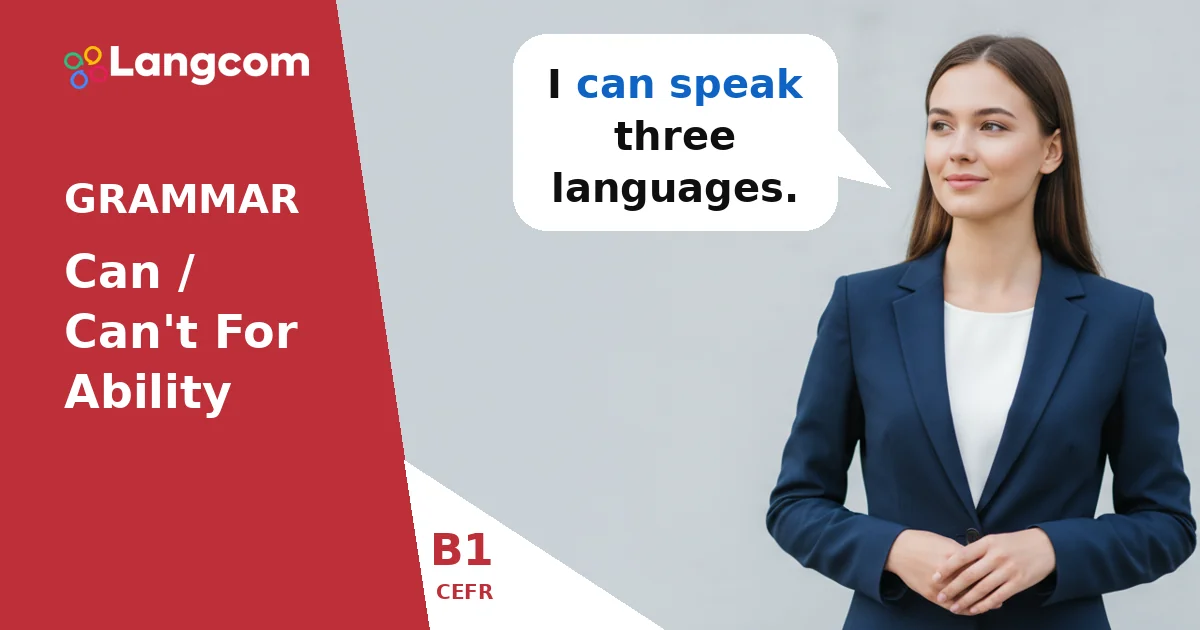

What Does Can Mean in English?
Can is a modal verb. We use can to talk about abilities, skills, or possibilities that exist in the present.
It means that someone has the knowledge, skill, or opportunity to do something.
- Structure: Subject + can + base form of verb
🎓 Englisch lernen mit der Blended-Methode
Kleingruppen · KI-Tutor rund um die Uhr · Vorbereitung auf die Cambridge-Prüfungen
Pläne von $39 $79 pro Monat
How Do We Use Can't?
Can't ist die Verneinungsform von can. It means cannot. We use can't to express a lack of ability, skill, or possibility in the present.
It tells us that someone is not able to do something.
- Structure: Subject + can't + base form of verb
Asking About Ability: Can Questions
To ask if someone has an ability, we put can at the beginning of the sentence.
Wir verwenden can before the subject to form questions.
- Structure: Can + subject + base form of verb?
Für kurze Antworten verwenden wir Yes, subject + can. oder No, subject + can't.
Important Rules for Can and Can't
Can und can't are special verbs called modal verbs. They follow specific rules:
- No 'to' after can: Always use the base form of the main verb directly after can, without 'to'.
Beispiel: I can swim. (NOT I can to swim.) - Same form for all subjects: Can does not change for 'he', 'she', or 'it'. It stays the same for all subjects.
Beispiel: He can speak Spanish. (NOT He cans speak Spanish.) - No auxiliary verbs: We do not use do oder does mit can for questions or negatives.
Beispiel: Can you help me? (NOT Do you can help me?)
| Form | Beispielsatz |
|---|---|
| Positive | I can swim. |
| Negative | She can't sing. |
| Question | Can you dance? |
| Short Answer (Yes) | Yes, I can. |
| Short Answer (No) | No, I can't. |
Beispiele
- I can speak three languages.
- She can play the piano very well.
- My brother can't cook at all.
- We can't go to the party tonight.
- Can you help me with this exercise?
- Can they understand English?
- Yes, I can.
- No, he can't.
Übung
✍️ Du bist dir nicht sicher, auf welchem Niveau du bist?
Machen Sie unseren kostenlosen Einstufungstest und erhalten Sie individuelles Feedback von zertifizierten Cambridge-Prüfern.
Machen Sie unseren KOSTENLOSEN EinstufungstestHäufige Fehler bei Spanischsprechern
Many Spanish speakers might incorrectly add 'to' after can, similar to how they might use 'poder + infinitivo' in Spanish.
- Falsch: I can to speak English.
- Richtig: I can speak English.
Another common error is changing the form of can for different subjects, especially for 'he/she/it'.
- Falsch: She cans sing.
- Richtig: She can sing.
Also, avoid using auxiliary verbs like do oder don't mit can for questions or negatives.
- Falsch: Do you can play tennis?
- Richtig: Can you play tennis?
Häufig gestellte Fragen
What is the difference between can and be able to?
Can is more common for general present ability. Be able to is more formal and can be used in all tenses, especially when can is not grammatically possible (e.g., future: I will be able to help you.).
Can 'can' be used for permission?
Ja, can can also be used to ask for or give permission (e.g., Can I sit here? oder You can go now.). However, this lesson focuses on its use for ability.
Is 'can' used for future ability?
No, for future ability, we typically use will be able to. Zum Beispiel:, I will be able to visit next week. (NOT I can visit next week if you mean future ability).
How is 'can' different from 'could'?
Can is used for present ability (e.g., I can run fast now.). Could is the past form of can and is used for past ability (e.g., When I was young, I could run fast.).

0 Kommentare