

What are Adjective-Noun Collocations?
Collocations are simply words that frequently appear together. Adjective-noun collocations are specific pairs where an adjective and a noun are commonly used side-by-side.
These combinations sound ‘right’ to native speakers, while other combinations might sound unnatural, even if grammatically correct. For example, we say strong coffee, nicht powerful coffee.
✍️ Du bist dir nicht sicher, auf welchem Niveau du bist?
Machen Sie unseren kostenlosen Einstufungstest und erhalten Sie individuelles Feedback von zertifizierten Cambridge-Prüfern.
Machen Sie unseren KOSTENLOSEN EinstufungstestWhy are Collocations Important for C1 English?
At the C1 level, you need to express yourself with greater accuracy and sophistication. Collocations allow you to do this.
- Precision: They help you convey exact meanings. For instance, a major problem is more specific than a big problem.
- Naturalness: Using correct collocations makes your English sound more authentic and fluent.
- Vocabulary Expansion: Learning words in pairs or groups is an effective way to expand your active vocabulary.
- Exam Success: The C1 Advanced (CAE) exam often tests your knowledge of collocations, especially in reading and use of English sections.
Common C1 Adjective-Noun Collocations to Learn
Many common mistakes at the C1 level involve using general adjectives when more precise ones are needed. Here are some examples:
- Instead of big problem, verwende serious problem oder major problem.
- Instead of big decision, verwende crucial decision oder tough decision.
- Instead of big opportunity, verwende great opportunity oder unique opportunity.
- Instead of big success, verwende resounding success oder tremendous success.
- Instead of big difference, verwende significant difference oder marked difference.
- Instead of big amount, verwende considerable amount oder substantial amount.
- Instead of big rain, verwende heavy rain.
- Instead of good insight, verwende valuable insight.
- Instead of big priority, verwende high priority.
How to Learn Adjective-Noun Collocations Effectively?
Learning collocations requires active engagement and exposure to English.
- Read Widely: Pay attention to adjective-noun pairs in books, articles, and news. Notice how words combine.
- Listen Actively: When watching films, TV shows, or podcasts, try to identify and note down collocations.
- Keep a Collocation Notebook: Organize new collocations by topic or by the noun. Write example sentences.
- Use a Collocation Dictionary: These specialized dictionaries can show you common partners for words.
- Practice in Context: Try to use new collocations in your speaking and writing as soon as you learn them.
| Adjektiv | Noun |
|---|---|
| considerable | amount, effort, difference |
| heavy | rain, traffic, workload |
| high | priority, standard, expectation |
| major | problem, issue, impact |
| significant | change, increase, improvement |
| strong | argument, evidence, possibility |
| tremendous | success, effort, challenge |
| valuable | insight, asset, experience |
| wide | range, variety, selection |
Beispiele
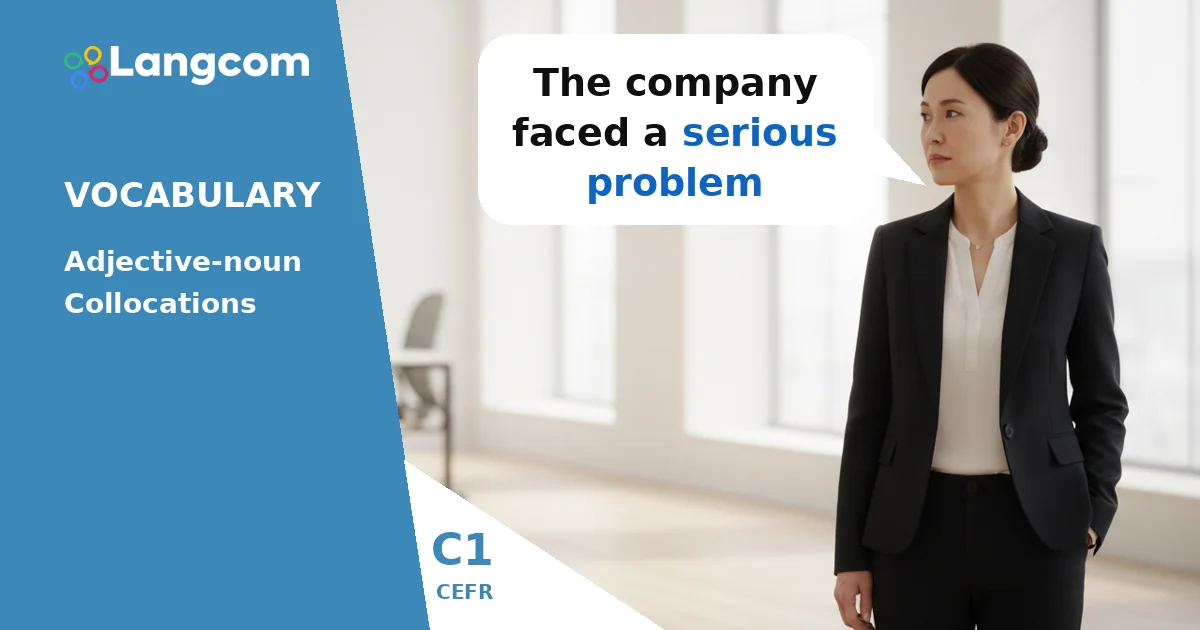
- The company faced a serious problem with its new software.
- Making such a crucial decision requires careful thought.
- This project offers a great opportunity for career advancement.
- The launch was a resounding success, exceeding all expectations.
- There is a significant difference between the two proposals.
- We received a considerable amount of feedback from users.
- The heavy rain caused flooding in several areas.
- Her research provided valuable insight into the topic.
- Ensuring customer satisfaction is a high priority for our team.
Übung
Bist du bereit, dein Zertifikat zu erwerben?
Der Kurs Langcom bereitet die Teilnehmer auf die Prüfungen von Cambridge, IELTS, TOEFL, DELE, SIELE und Michigan vor.
Erste Schritte mit LangcomHäufige Fehler bei Spanischsprechern
A very common mistake for Spanish speakers, and many other learners, is overusing the adjective big. In Spanish, words like 'grande' can cover a wide range of meanings, leading to direct translations that sound unnatural in English.
- Falsch: We had a big discussion about the future.
- Richtig: We had a heated discussion about the future. (Or long discussion, serious discussion)
- Falsch: She made a big mistake.
- Richtig: She made a serious mistake. (Or grave mistake)
- Falsch: The company has a big reputation.
- Richtig: The company has a strong reputation. (Or excellent reputation)
Always aim for the most precise and natural-sounding adjective for the noun.
Häufig gestellte Fragen
What is the difference between a collocation and an idiom?
A collocation is a natural pairing of words, like fast food, where both words keep their literal meaning. An idiom is a phrase where the meaning cannot be understood from the individual words, like kick the bucket (meaning to die).
How can I improve my collocations for the C1 Advanced exam?
For the C1 Advanced (CAE) exam, focus on extensive reading and listening to authentic English materials. Pay close attention to how adjectives and nouns combine. Practice using new collocations in your writing and speaking. The 'Use of English' section, especially Part 1 (Multiple-choice cloze), often tests your knowledge of collocations.
Are there rules for forming adjective-noun collocations?
Unfortunately, there are no strict grammatical rules for forming collocations; they are largely arbitrary and learned through exposure. The best way to learn them is to notice them in context and memorize them as fixed units, rather than trying to guess.
Can I use a thesaurus to find collocations?
While a thesaurus can suggest synonyms, it doesn't guarantee that the synonyms will collocate naturally with a particular noun. It's better to use a dedicated collocation dictionary or a good learner's dictionary that provides example sentences with common collocations.


0 Kommentare