

Who are the Key People in Sport?
When we talk about sport, we often describe the people involved. There are specific words for different roles.
- A champion is a person who has won a competition, especially at the highest level. They are the best!
- Ein athlete is a person who competes in sports. This word is often used for people in track and field, but it can apply to anyone who is very good at physical sports.
- A competitor is simply a person who takes part in a competition. There can be many competitors, but only one champion.
- A professional is someone who does a sport or activity as their job, not just as a hobby. We can use it as an adjective or a noun.
✍️ Du bist dir nicht sicher, auf welchem Niveau du bist?
Machen Sie unseren kostenlosen Einstufungstest und erhalten Sie individuelles Feedback von zertifizierten Cambridge-Prüfern.
Machen Sie unseren KOSTENLOSEN EinstufungstestHow Do We Describe Actions and Results in Sport?
Sport involves actions and results. We have specific verbs and nouns to describe these.
- An perform means to do an action or activity, especially one that requires skill. In sport, it describes how well a player or team plays.
- A victory is an act of winning a game, competition, election, or war. It is the opposite of defeat.
What Are Important Sport Events Called?
Sporting events come in many forms, but some are very important.
- Championships (usually plural) are competitions to find the best player or team in a particular sport or league. For example, the World Cup is a football championship.
Using 'Professional' as an Adjective or Noun
Das Wort professional can describe a person or a type of sport.
- As an adjective, it describes something done for money, not just for fun. For example, professional football.
- As a noun, a professional is a person who plays a sport for money. For example, He is a golf professional.
| Wort | Part of Speech | Bedeutung |
|---|---|---|
| champion | Noun | A person who has won a competition. |
| perform | Verb | To do an action, especially one requiring skill. |
| competitor | Noun | A person who takes part in a competition. |
| championships | Noun (plural) | A competition to find the best player/team. |
| victory | Noun | An act of winning a game or competition. |
| athlete | Noun | A person who competes in sports. |
| professional | Adjective/Noun | Doing an activity as a job; a person who does so. |
Beispiele
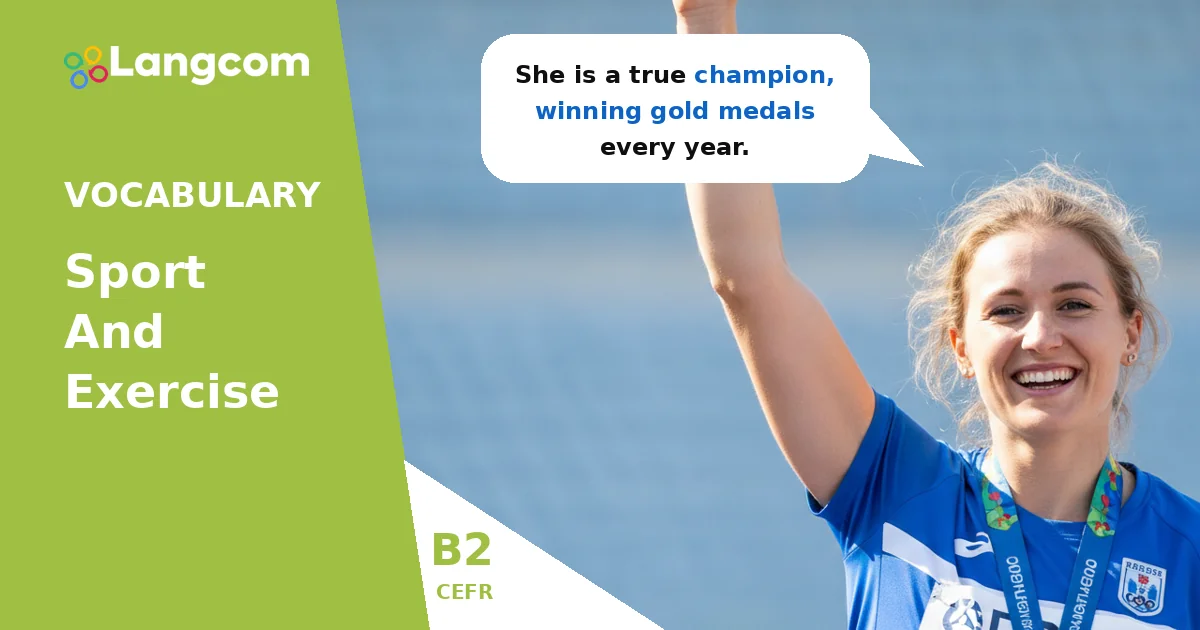
- She is a true champion, winning gold medals every year.
- The team performed exceptionally well in the second half of the game.
- There were over a hundred competitors in the marathon.
- He trained hard for the world championships.
- The victory was celebrated by all the fans.
- Many athletes dream of competing in the Olympics.
- She decided to become a professional tennis player.
Übung
Bist du bereit, dein Zertifikat zu erwerben?
Der Kurs Langcom bereitet die Teilnehmer auf die Prüfungen von Cambridge, IELTS, TOEFL, DELE, SIELE und Michigan vor.
Erste Schritte mit LangcomHäufige Fehler bei Spanischsprechern
Häufige Fehler bei Spanischsprechern
- Using 'champion' for the event: In Spanish, 'campeonato' refers to the event. In English, champion is the *person* who wins. The event is championships.
Falsch: The champion was exciting. (Meaning the event)
Richtig: The championships were exciting. ODER The champion played excitingly. - Using 'win' as a noun for the result: In Spanish, 'victoria' is common. In English, use victory.
Falsch: It was a great win for the team. (While 'win' can be a noun, victory is more formal and often preferred for a significant success).
Richtig: It was a great victory for the team. - Using 'sportist' instead of 'athlete': This is a direct translation error from Spanish 'deportista'. In English, use athlete oder sportsman/sportswoman.
Falsch: He is a very good sportist.
Richtig: He is a very good athlete.
Häufig gestellte Fragen
What is the difference between an 'athlete' and a 'competitor'?
Ein athlete is generally someone skilled in physical sports, often implying a high level of fitness and training. A competitor is simply anyone who takes part in a competition, regardless of their skill level or the type of competition. All athletes are competitors when they compete, but not all competitors are athletes.
Can 'professional' be used for other jobs, not just sport?
Yes, absolutely! Professional can describe anyone who does a job that requires special training or education, like a professional doctor oder a professional lawyer. It also means doing something for money, not as a hobby, in any field.
Is 'championship' always plural?
Nein, championship can be singular, referring to one specific competition, like the Wimbledon Championship. However, it is very common to use the plural form, championships, especially when talking about a series of events or a general concept, such as world championships oder national championships.




0 Kommentare