

What are Possessive Adjectives and Possessive Pronouns?
Possessive adjectives and possessive pronouns both show who owns something. They are similar but work in different ways.
- Possessive Adjectives always come before a noun. They describe the noun.
Examples:
- This is my car.
- Is that your phone?
- She lives with her parents.
- Possessive Pronouns stand alone. They replace a possessive adjective + a noun. This helps us avoid repeating words.
Examples:
- This car is mine. (Instead of ‘my car’)
- Is that phone yours? (Instead of ‘your phone’)
- That house is theirs. (Instead of ‘their house’)
Remember, the possessive adjective its does not have a possessive pronoun form.
🎓 Englisch lernen mit der Blended-Methode
Kleingruppen · KI-Tutor rund um die Uhr · Vorbereitung auf die Cambridge-Prüfungen
Pläne von $39 $79 pro Monat
How Do We Use the Possessive ‘s?
We use the apostrophe ‘s to show that a person or animal owns something. It is very common in English.
- For singular nouns and names: Add ‘s to the end of the word.
Examples:
- This is Maria’s book. (The book belongs to Maria.)
- That is the dog’s toy. (The toy belongs to the dog.)
- For plural nouns ending in -s: Just add an apostrophe ‘ after the -s.
Examples:
- These are the students’ desks. (The desks belong to the students.)
- My parents’ car is new. (The car belongs to my parents.)
Be careful! ‘s can also be a short form for is oder has. The meaning depends on the sentence.
- He‘s a doctor. (He is a doctor.)
- She‘s got a new phone. (She has got a new phone.)
How Do We Ask About Possession?
To ask who something belongs to, we use the word Whose.
- You can use Whose before a noun.
Examples:
- Whose jacket is this?
- Whose keys are those?
- You can also use Whose alone, after the verb.
Examples:
- Whose is this jacket?
- Whose are those keys?
| Subject | Possessive Adjective | Possessive Pronoun |
|---|---|---|
| I | my | mine |
| You | your | yours |
| He | his | his |
| She | her | hers |
| It | its | – |
| We | our | ours |
| They | their | theirs |
Examples
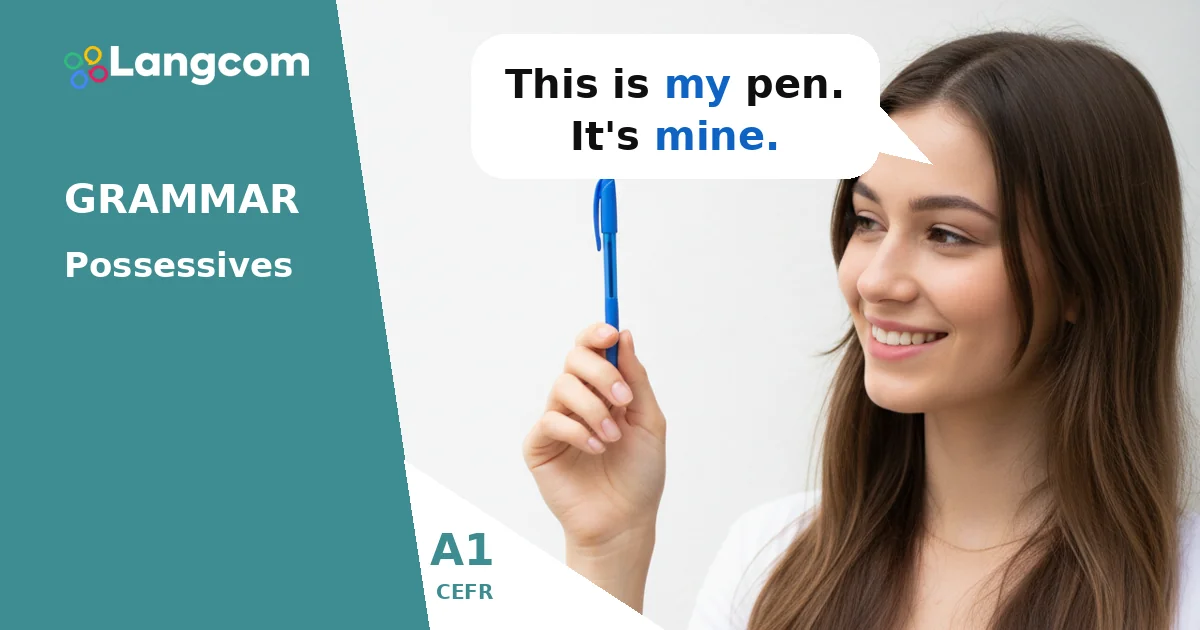
- This is my pen. It’s mine.
- That is your bag. Is it yours?
- He has a new phone. It’s his.
- She loves her cat. The cat is hers.
- We live in our house. The house is ours.
- They found their dog. The dog is theirs.
- This is my brother’s room.
- The children’s toys are everywhere.
- Whose car is parked outside?
Practice
💬 Benötigen Sie eine individuelle Beratung?
Als autorisiertes Cambridge-Vorbereitungszentrum können wir Ihnen helfen, den richtigen Kurs und die passende Zertifizierung zu finden. Chatten Sie noch heute mit unseren Beratern.
Chatten Sie mit einem Berater auf WhatsAppCommon mistakes for Spanish speakers
Many Spanish speakers sometimes make these mistakes:
- Using a possessive adjective without a noun: In Spanish, you can often use a possessive word alone (e.g., ‘es mío’). In English, possessive adjectives always need a noun after them. You must use a possessive pronoun instead.
- Wrong: This book is my.
- Correct: This book is mine.
- Wrong: That is your.
- Correct: That is yours.
- Confusing it’s und its:
- It’s means it is oder it has. Example: It’s a beautiful day.
- Its is a possessive adjective. Example: The dog wagged its tail.
Häufig gestellte Fragen
What is the difference between ‘my’ and ‘mine’?
My is a possessive adjective. It always comes before a noun, like in my book. Mine is a possessive pronoun. It replaces ‘my + noun’, so it stands alone, like in This book is mine.
When do I use ‘s and when do I use ‘ for possession?
You use ‘s for singular nouns and names (e.g., John’s car, the cat’s toy). You use just ‘ (the apostrophe after the -s) for plural nouns that already end in -s (e.g., the students’ books, my parents’ house).
Does ‘its’ have a possessive pronoun form?
No, its is only a possessive adjective (e.g., The tree lost its leaves.). There is no possessive pronoun form for it.
Can I use ‘whose’ to ask about people and things?
Yes, you can use Whose to ask about possession for both people and things. For example, Whose jacket is this? (for a person) or Whose car is that? (for a thing).

0 Kommentare