

What Are Common Objects?
Common objects are things we see and use every day. They are often found in our homes, schools, or offices. Learning their names in English is very useful for basic communication.
For example, in your living room, you might see a sofa, a television, and a lamp.
🎓 Englisch lernen mit der Blended-Methode
Kleingruppen · KI-Tutor rund um die Uhr · Vorbereitung auf die Cambridge-Prüfungen
Pläne von $39 $79 pro Monat
Everyday Objects in Your Home
Let’s look at some common objects you can find in different rooms.
- In the kitchen: a cup, a glass, a plate.
- In the living room: a chair, a table, a lamp, a picture.
- In the bedroom: a bed, a clock.
- For personal use: a book, a bag, a suitcase.
How Do We Use ‘A’ or ‘An’ with Objects?
In English, we use a oder an before a singular common object. These are called indefinite articles.
- Use a before words that start with a consonant sound: a book, a chair, a lamp.
- Use an before words that start with a vowel sound (a, e, i, o, u): an apple, an orange.
Remember, it’s about the sound, not just the letter!
Singular and Plural Forms of Objects
Most common objects have singular (one) and plural (more than one) forms. We usually add -s oder -es to make a word plural.
- Add -s for most words: one book, two books; one chair, three chairs.
- Add -es for words ending in -s, -ss, -sh, -ch, -x, -z: one glass, two glasses; one box, many boxes.
| Singular | Plural |
|---|---|
| a book | books |
| a chair | chairs |
| a lamp | lamps |
| a glass | glasses |
| a box | boxes |
| a radio | radios |
| a clock | clocks |
| a picture | pictures |
Examples
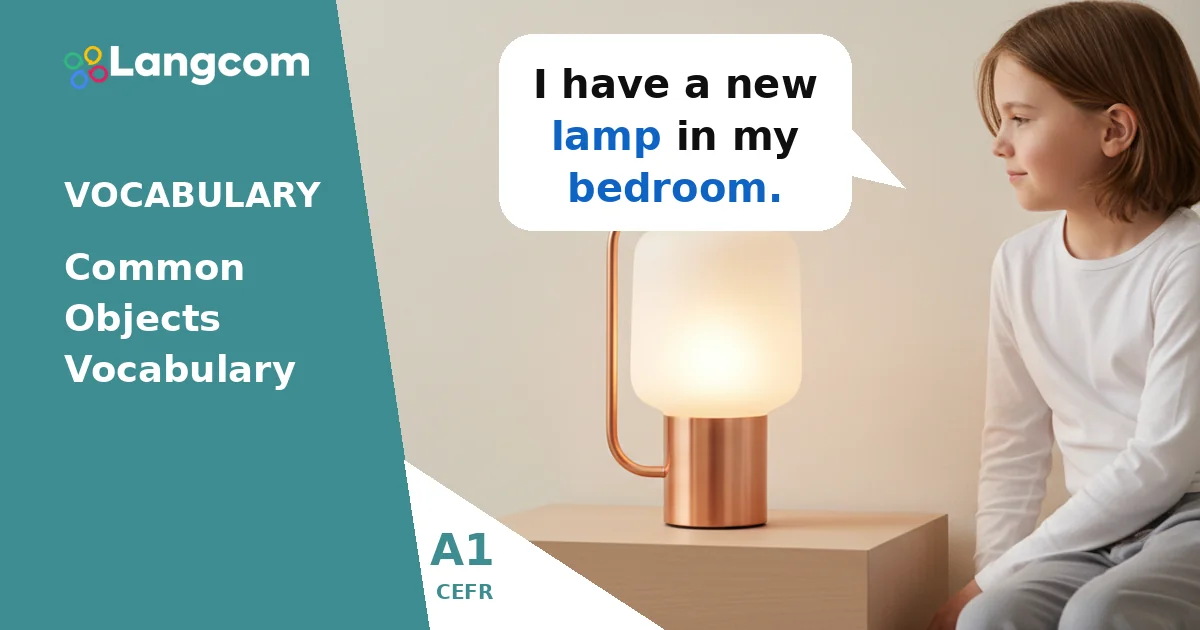
- I have a new lamp in my bedroom.
- There are two chairs in the kitchen.
- She is reading a book.
- Can I have a glass of water, please?
- My bag is on the table.
- The clock is on the wall.
- I saw a beautiful picture at the museum.
Practice
💬 Benötigen Sie eine individuelle Beratung?
Als autorisiertes Cambridge-Vorbereitungszentrum können wir Ihnen helfen, den richtigen Kurs und die passende Zertifizierung zu finden. Chatten Sie noch heute mit unseren Beratern.
Chatten Sie mit einem Berater auf WhatsAppCommon mistakes for Spanish speakers
Spanish speakers sometimes make these mistakes:
- Omitting ‘a’ or ‘an’: In Spanish, you often don’t use an article for “a” or “an” when talking about general things. In English, it’s usually necessary for singular countable nouns.
- Incorrect: I have book.
- Correct: I have a book.
- Confusing gender: English nouns do not have gender like in Spanish (e.g., “el libro,” “la mesa”). All objects are “it.”
- Incorrect: The table is big. He is brown. (referring to the table)
- Correct: The table is big. It is brown.
- Incorrect pluralization: Sometimes adding -es when only -s is needed, or vice-versa.
- Incorrect: Two glass.
- Correct: Two glasses.
Häufig gestellte Fragen
Why is it important to learn common object names?
Learning common object names helps you describe your home, ask for things, and understand everyday conversations in English. It’s basic vocabulary for A1 level.
How can I remember new object words easily?
Try labeling objects in your home with their English names. You can also draw pictures or use flashcards. Practice saying the words aloud often.
What is the difference between ‘a’ and ‘an’?
We use a before words that start with a consonant sound (e.g., a book). We use an before words that start with a vowel sound (e.g., an apple).
Are there other words for ‘picture’?
Yes, photograph is a common word for a picture taken with a camera. Painting is also a type of picture made with paint.



0 Kommentare