

Why are B2 Character Adjectives Important?
At the B2 level, your English should allow for more detailed and nuanced descriptions. Basic adjectives like good oder bad are not enough to truly capture a person’s character.
Using B2 character adjectives helps you:
- Express yourself clearly: You can describe exactly what you mean.
- Understand others better: You will grasp the subtle meanings when native speakers describe people.
- Sound more natural: Your English will become more fluent and sophisticated.
- Improve your writing: Stronger vocabulary makes your essays and reports more impactful.
✍️ Du bist dir nicht sicher, auf welchem Niveau du bist?
Machen Sie unseren kostenlosen Einstufungstest und erhalten Sie individuelles Feedback von zertifizierten Cambridge-Prüfern.
Machen Sie unseren KOSTENLOSEN EinstufungstestPositive B2 Personality Traits
Here are some useful B2 adjectives to describe positive aspects of someone's personality:
- Conscientious: Someone who is careful, thorough, and diligent in their work or duties. They always try to do things correctly.
- Gregarious: A person who enjoys being with other people; sociable and outgoing. They love social interaction.
- Resilient: Someone who can recover quickly from difficulties; tough and adaptable. They don't give up easily after challenges.
- Empathetic: A person who understands and shares the feelings of another. They can put themselves in someone else's shoes.
- Meticulous: Someone who shows great attention to detail; very careful and precise. They pay close attention to small things.
Challenging B2 Personality Traits
Sometimes, we need to describe less positive or more complex aspects of personality. These adjectives help you do that:
- Impulsive: A person who acts without thinking carefully about the possible results. They make quick decisions without planning.
- Arrogant: Someone who has an exaggerated sense of their own importance or abilities. They often think they are better than others.
- Gullible: A person who is easily persuaded to believe something; easily tricked. They trust people too quickly.
- Obstinate: Someone who is stubbornly refusing to change their opinion or chosen course of action, despite attempts to persuade them to do so. They are very determined and unwilling to change.
How to Use Character Adjectives in Sentences
Character adjectives are typically used before a noun or after a linking verb (like be, seem, become).
- Vor einem Substantiv: She is a very conscientious student.
- After a linking verb: He seems quite gregarious at parties.
You can also use adverbs to modify these adjectives, making your descriptions even more precise.
- He is incredibly resilient in difficult situations.
- She can be surprisingly impulsive sometimes.
| Adjektiv | Meaning (Simple English) | Example Usage |
|---|---|---|
| Conscientious | Careful and thorough; always tries to do things well. | She is a conscientious student who always submits excellent work. |
| Gregarious | Likes being with other people; sociable. | He is very gregarious and loves attending parties. |
| Resilient | Able to recover quickly from problems or difficulties. | After losing her job, she proved to be incredibly resilient. |
| Empathetic | Able to understand and share the feelings of others. | An empathetic friend always knows how to comfort you. |
| Impulsive | Acts without thinking about the consequences. | Buying that expensive car was an impulsive decision. |
| Arrogant | Thinks they are better or more important than others. | His arrogant comments made everyone uncomfortable. |
| Gullible | Easily tricked or persuaded to believe things. | The scammer took advantage of the gullible old man. |
Beispiele
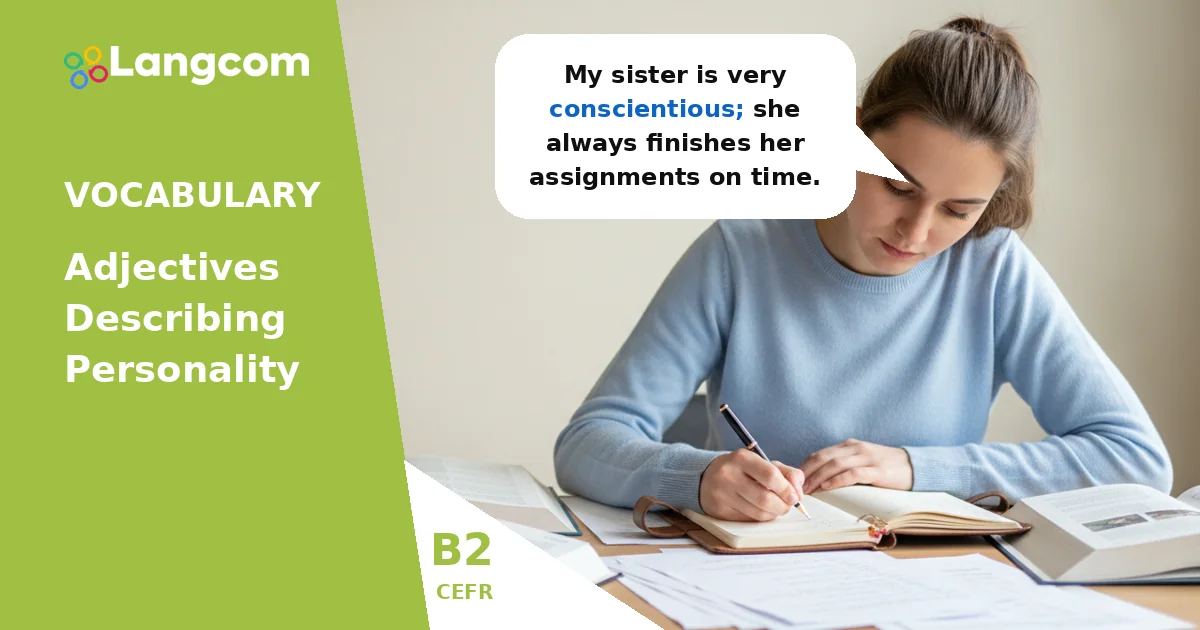
- My sister is very conscientious; she always finishes her assignments on time.
- Despite the setbacks, the team remained resilient and achieved their goal.
- He is so gregarious that he makes friends everywhere he goes.
- A truly empathetic leader understands the needs of their employees.
- Her meticulous planning ensured the project was a success.
- Don't be so impulsive; think before you act.
- His arrogant attitude made him unpopular with his colleagues.
- It's easy to take advantage of someone who is too gullible.
- Even with strong arguments, he remained obstinate and refused to change his mind.
Übung
Bist du bereit, dein Zertifikat zu erwerben?
Der Kurs Langcom bereitet die Teilnehmer auf die Prüfungen von Cambridge, IELTS, TOEFL, DELE, SIELE und Michigan vor.
Erste Schritte mit LangcomHäufige Fehler bei Spanischsprechern
Häufige Fehler bei Spanischsprechern
Spanish speakers often make specific mistakes when using English character adjectives:
- Verwirrend Sensitive und Sensible: In Spanish, 'sensible' means sensitive (easily affected emotionally). In English, sensible means practical and reasonable. For example, Incorrect: He is a very sensible person and cries easily. Correct: He is a very sensitive person and cries easily.
- Direct Translation of Sympathetic: While related to 'simpático' in Spanish, sympathetic in English means showing understanding and pity for someone's misfortune. It doesn't mean 'friendly' or 'nice' in the same way 'simpático' does. For example, Incorrect: My new colleague is very sympathetic. (if you mean friendly) Correct: My new colleague is very friendly. (oder nice, gregarious).
- Using Adjectives as Adverbs: Remember that adjectives describe nouns, while adverbs describe verbs, adjectives, or other adverbs. For example, Incorrect: He works hard-working. Correct: He works hard. (Hier, hard is an adverb). Or, Correct: He is a hard-working person. (Hier, hard-working is an adjective).
Häufig gestellte Fragen
What is the difference between 'shy' and 'introverted'?
Shy means feeling nervous or uncomfortable in social situations. Introverted describes someone who gets energy from being alone and can find social interaction draining, but they are not necessarily nervous. An introverted person might not be shy at all.
Can one person have many character adjectives?
Yes, absolutely! People are complex. Someone can be conscientious at work but impulsive in their free time. Using a variety of adjectives helps create a more complete picture of a person.
How can I remember new B2 character adjectives?
Try to associate new adjectives with people you know or characters from books/movies. Use them in sentences about these people. You can also group them by synonyms or antonyms, or by positive and negative traits. Regular practice is key.


0 Kommentare