

Why Do Modal Verbs Have Different Sounds?
English pronunciation often changes depending on how important a word is in a sentence. This is especially true for small, common words like modal verbs.
- When a modal verb is not important for the main meaning, it often has a ‘weak’ sound.
- When it is important (for emphasis, negation, or at the end of a sentence), it has a ‘strong’ sound.
Learning this helps you sound more like a native speaker and understand spoken English better.
✍️ Du bist dir nicht sicher, auf welchem Niveau du bist?
Machen Sie unseren kostenlosen Einstufungstest und erhalten Sie individuelles Feedback von zertifizierten Cambridge-Prüfern.
Machen Sie unseren KOSTENLOSEN EinstufungstestUnderstanding Weak Forms: The Schwa Sound
The weak form of many modal verbs uses the 'schwa' sound, which is /ə/. This sound is very common in English. It is a short, relaxed 'uh' sound.
- When a modal verb is unstressed, its vowel sound often changes to a schwa.
- Zum Beispiel, can usually sounds like /kən/, nicht /kæn/.
- This makes sentences flow faster and sound more natural.
When Do We Use Strong Forms?
We use the strong form of a modal verb in specific situations:
- For emphasis: If you want to stress the modal verb's meaning. For example, I CAN do it! (meaning 'I am able to do it, despite difficulties').
- In negative forms: Negative modal verbs like can't, couldn't, und shouldn't are almost always pronounced with their strong form. The 'not' part makes them stressed.
- At the end of a sentence: If a modal verb is the last word in a sentence, it usually takes its strong form. For example, Yes, I can.
Pronunciation Guide: Can, Could, Should
Let's look at the specific weak and strong forms for some common B1 modal verbs:
- Can:
- Weak form: /kən/ (most common). Example: I can help.
- Strong form: /kæn/ (for emphasis or at the end). Example: Yes, I can.
- Could:
- Weak form: /kəd/. Example: We could go.
- Strong form: /kʊd/ (for emphasis or at the end). Example: I said we could!
- Should:
- Weak form: /ʃəd/. Example: You should try.
- Strong form: /ʃʊd/ (for emphasis or at the end). Example: I think you should.
What About Negative Modals?
Negative modal verbs are almost always pronounced with their strong form because the 'not' part adds stress.
- Can't: /kɑːnt/ oder /kænt/ (depending on accent). Example: I can't go.
- Couldn't: /ˈkʊdnt/. Example: She couldn't hear.
- Shouldn't: /ˈʃʊdnt/. Example: You shouldn't worry.
Notice that the vowel sound is clearer and stronger than in the weak positive forms.
| Modalverb | Weak Form (Unstressed) | Strong Form (Stressed/Negative/End) |
|---|---|---|
| Can | /kən/ | /kæn/ |
| Can't | N/A (always strong) | /kɑːnt/ oder /kænt/ |
| Could | /kəd/ | /kʊd/ |
| Couldn't | N/A (always strong) | /ˈkʊdnt/ |
| Should | /ʃəd/ | /ʃʊd/ |
| Shouldn't | N/A (always strong) | /ˈʃʊdnt/ |
Beispiele
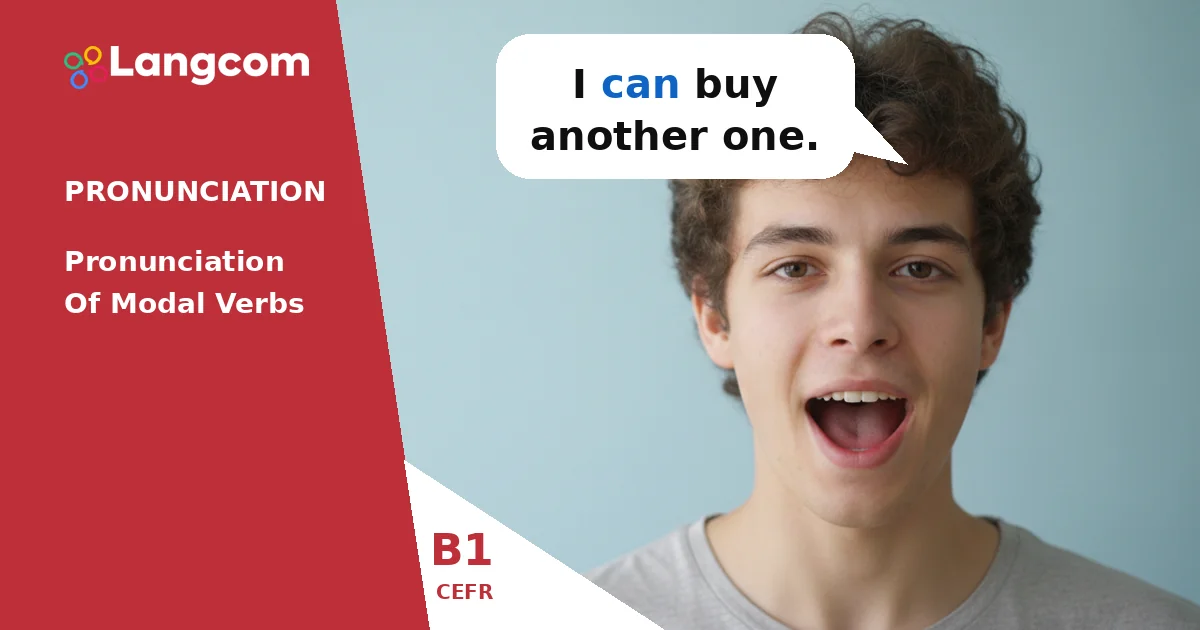
- I can buy another one.
- I can't afford that one.
- I could meet you at 5.30.
- I couldn't live without my phone!
- I should get up earlier on Sundays.
- I shouldn't go to bed so late.
- Can you help me?
- Yes, I can.
Übung
Bist du bereit, dein Zertifikat zu erwerben?
Der Kurs Langcom bereitet die Teilnehmer auf die Prüfungen von Cambridge, IELTS, TOEFL, DELE, SIELE und Michigan vor.
Erste Schritte mit LangcomHäufige Fehler bei Spanischsprechern
A common mistake for Spanish speakers is to always pronounce modal verbs with their strong form, even when they should be weak. For example, saying /kæn/ in I can swim instead of the more natural /kən/.
This can make your English sound less natural and sometimes harder for native speakers to understand, as the rhythm of the sentence is different. Remember, the weak form is very common!
Häufig gestellte Fragen
What is the 'schwa' sound?
The schwa sound, written as /ə/, is a very common, unstressed vowel sound in English. It sounds like a short, relaxed 'uh' and is often found in weak forms of words like can (/kən/) or should (/ʃəd/).
Why is it important to learn weak and strong forms?
Learning weak and strong forms is crucial for B1 English learners because it significantly improves both your speaking fluency and your listening comprehension. You'll sound more natural and understand spoken English more easily.
Do all modal verbs have weak and strong forms?
Many common modal verbs, especially those used frequently like can, could, should, und must, have distinct weak and strong forms. Less common or more emphatic modals might primarily use their strong form.
How can this help me in the B1 Preliminary exam?
Understanding weak and strong forms will help you in the B1 Preliminary Speaking test by making your pronunciation more accurate and natural. It will also improve your ability to understand native speakers in the Listening test, as these forms are very common in everyday speech.




0 Kommentare