
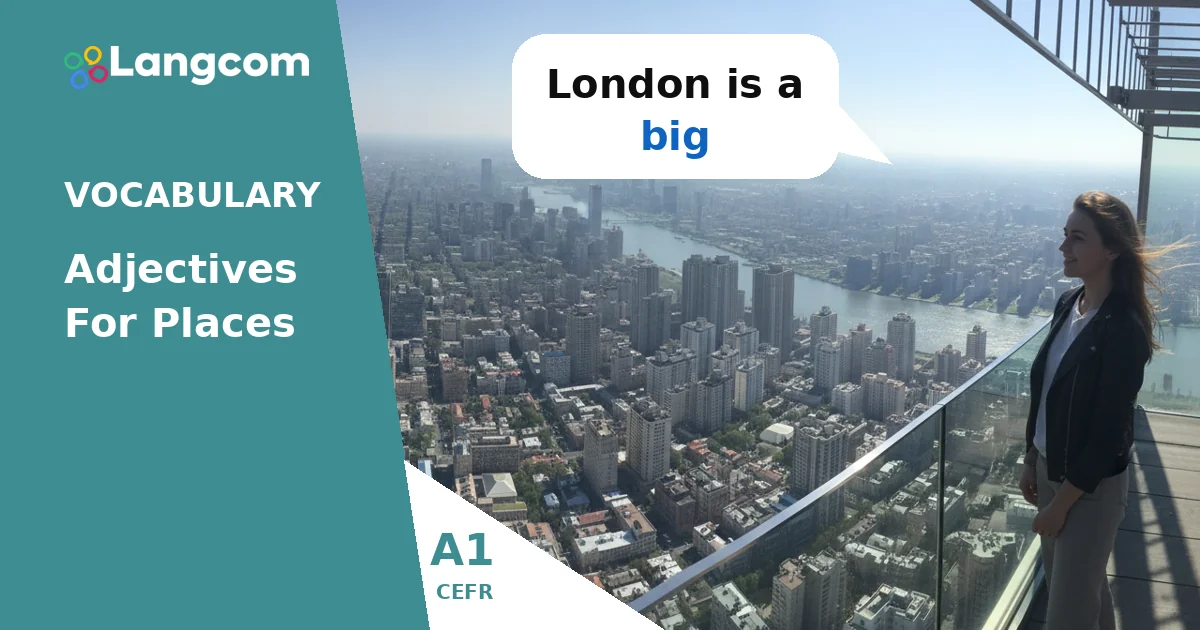

What are Adjectives for Places?
Adjectives are words that describe nouns. When we talk about places, adjectives help us say what they are like.
- They tell us about size: big oder small.
- They tell us about cleanliness: clean oder dirty.
- They tell us about feelings: exciting oder boring.
Using adjectives makes your English descriptions much better!
[langcom_cta variant=”blended”]
How Do We Use Adjectives for Places?
In English, adjectives usually come before the noun they describe, or after the verb to be.
- Before the noun: It is a big city.
- After the verb to be: The city is big.
Both ways are correct and common. Choose the one that feels most natural for your sentence.
Common Adjectives and Their Opposites for Places
Learning adjectives in pairs of opposites is very helpful. Here are some common adjectives you can use to describe places:
- Big / Small: These describe the size of a place.
- Clean / Dirty: These describe how tidy or messy a place is.
- Exciting / Boring: These describe how interesting or dull a place feels.
- Cheap / Expensive: These describe the cost of things in a place.
- Dry / Wet: These describe the weather or condition of a place.
- Quiet / Noisy: These describe the sound level in a place.
- Hot / Cold: These describe the temperature of a place.
| Adjektiv | Opposite |
|---|---|
| Big | Small |
| Clean | Dirty |
| Exciting | Boring |
| Cheap | Expensive |
| Dry | Wet |
| Quiet | Noisy |
| Hot | Cold |
Beispiele
- London is a big city.
- My village is very small.
- The park is clean today.
- That restaurant is always dirty.
- New York is an exciting place to visit.
- The museum was a little boring.
- The market has very cheap clothes.
- Shopping in this area is expensive.
- The desert is a dry place.
- It was a wet day at the beach.
- My library is a very quiet place.
- The party was very noisy.
- It’s hot in the summer here.
- The mountains are cold in winter.
Übung
[langcom_cta variant=”whatsapp”]
Häufige Fehler bei Spanischsprechern
A common mistake for Spanish speakers is putting the adjective after the noun, like in Spanish. In English, adjectives usually come vor das Substantiv.
- Falsch: It is a city big.
- Richtig: It is a big city.
Remember: adjective + noun (z. B., clean park, exciting trip).
Häufig gestellte Fragen
Was ist ein Adjektiv?
An adjective is a word that describes a noun. It tells you more about a person, place, or thing. For example, in a big house, big ist das Adjektiv.
Can I use more than one adjective to describe a place?
Yes, you can! You can say It is a big, noisy city. Just put commas between the adjectives if there are two or more before the noun.
Do adjectives change for plural nouns?
No, English adjectives do not change. You say a big city und two big cities. The adjective big stays the same.


0 Kommentare