

Why Learn Body Parts in English?
Knowing the names of body parts in English is very useful. You use these words every day.
- You can describe yourself or other people. For example, She has long hair and blue eyes.
- You can talk about how you feel or if you are hurt. For example, My head hurts.
- It helps you understand descriptions and instructions.
This vocabulary is especially important for the Cambridge A2 Key (KET) exam. You might need to describe a person in a picture or talk about health.
✍️ Du bist dir nicht sicher, auf welchem Niveau du bist?
Machen Sie unseren kostenlosen Einstufungstest und erhalten Sie individuelles Feedback von zertifizierten Cambridge-Prüfern.
Machen Sie unseren KOSTENLOSEN EinstufungstestWhat are the Main Parts of Your Head and Face?
Dein head is the top part of your body. It contains your brain.
- Dein eye (plural: eyes) helps you see.
- Dein nose is in the middle of your face. You use it to smell and breathe.
- Dein ear (plural: ears) helps you hear sounds.
- Dein mouth is for eating, speaking, and smiling.
What are the Main Parts of Your Upper Body?
Die torso is the main part of your body, without your head, arms, and legs.
- Dein neck connects your head to your torso.
- Dein shoulder (plural: shoulders) is where your arm connects to your torso.
- Dein elbow is the middle part of your arm that bends.
- Dein wrist is the part that connects your hand to your arm.
- Dein hand (plural: hands) is at the end of your arm. You use it to hold things.
What are the Main Parts of Your Lower Body?
Dein leg (plural: legs) is the long part of your body that you use to walk and stand.
- Dein foot (plural: feet) is at the end of your leg. You stand and walk on your feet.
| Singular | Plural |
|---|---|
| foot | feet |
| tooth | teeth |
| hand | hands |
| ear | ears |
Beispiele
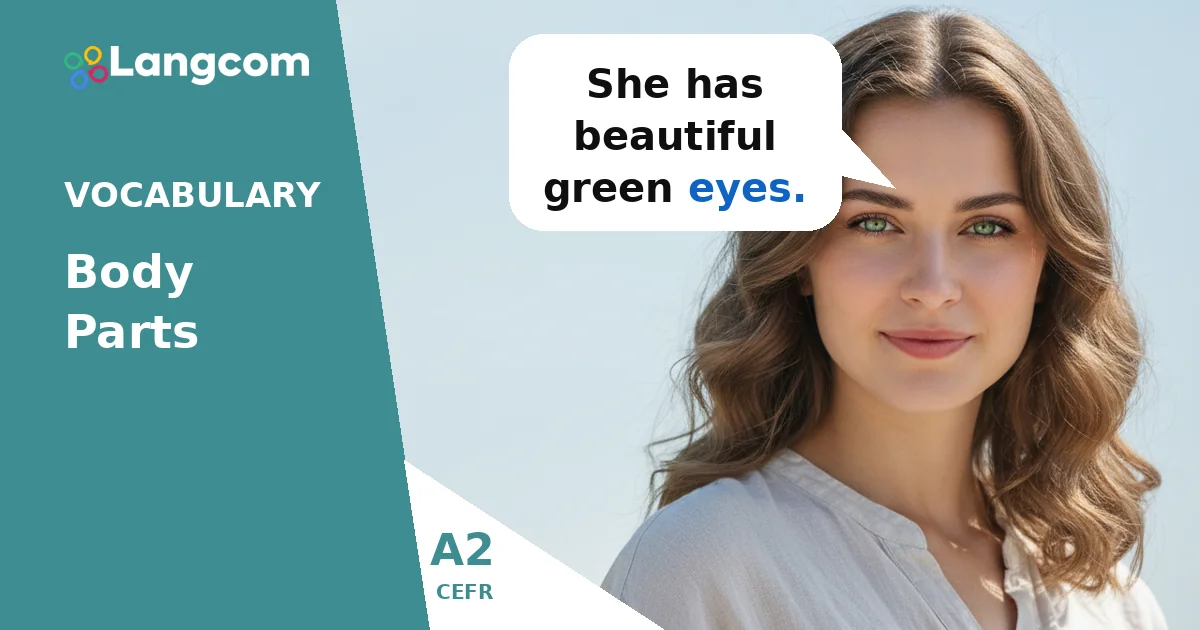
- She has beautiful green eyes.
- My nose is a little cold today.
- He hurt his hand playing basketball.
- The baby has very small feet.
- My neck feels stiff after sleeping.
- The doctor listened to my heart in my torso.
- Can you touch your elbow with your other hand?
- I wear my watch on my left wrist.
Übung
Bist du bereit, dein Zertifikat zu erwerben?
Der Kurs Langcom bereitet die Teilnehmer auf die Prüfungen von Cambridge, IELTS, TOEFL, DELE, SIELE und Michigan vor.
Erste Schritte mit LangcomHäufige Fehler bei Spanischsprechern
Spanish speakers sometimes make mistakes with singular and plural forms of body parts, especially irregular ones.
- Singular vs. Plural: Remember that some words have irregular plural forms. For example, the plural of foot ist feet, nicht foots. The plural of tooth ist teeth, nicht tooths.
- Using 'hair': Auf Englisch, hair is usually uncountable. We say She has long hair, nicht She has long hairs.
- Confusing 'arm' and 'hand': Ein arm is the whole limb from the shoulder to the hand. A hand is just the end part with fingers.
Häufig gestellte Fragen
Why is knowing body parts important for the A2 Key exam?
For the A2 Key exam, you might need to describe people in pictures, talk about health problems, or understand descriptions. Knowing words like head, eyes, und hands helps you complete these tasks successfully.
Are there different words for animal body parts?
Yes, sometimes. For example, animals have paws statt hands oder feet, and a snout instead of a nose. However, for A2 English, focus on human body parts first.
How can I remember these new body parts words?
Try these methods: use flashcards, label pictures of the human body, describe people you know, or use the words in simple sentences. Practice regularly to help you remember them.



0 Kommentare