
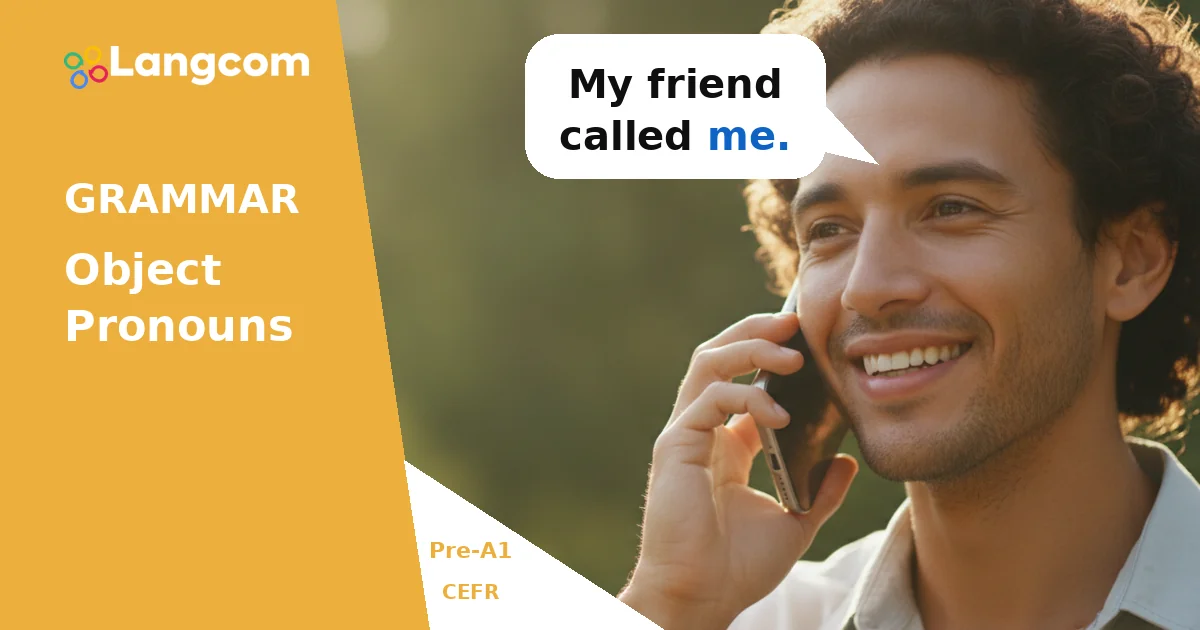

What Are Object Pronouns in English?
Object pronouns are special words in English grammar. They help us talk about who or what receives an action.
These pronouns replace nouns that are the ‘object’ of a verb or a preposition. This means they come after the verb or after a small word like to oder for.
- The English object pronouns are: me, you, him, her, it, us, them.
🎓 Englisch lernen mit der Blended-Methode
Kleingruppen · KI-Tutor rund um die Uhr · Vorbereitung auf die Cambridge-Prüfungen
Pläne von $39 $79 pro Monat
When Do We Use Object Pronouns?
We use object pronouns in two main situations:
- After a verb: The verb is the action word in the sentence. The object pronoun receives this action.
Zum Beispiel:
- She sees him. (him receives the action of sees)
- I like them. (them receives the action of like)
- After a preposition: Prepositions are small words like to, for, with, at, about. The object pronoun comes after these words.
Zum Beispiel:
- This gift is for you. (you comes after the preposition for)
- Talk to me. (me comes after the preposition to)
How Are Object Pronouns Different from Subject Pronouns?
It is important to know the difference between subject pronouns and object pronouns. They have different jobs in a sentence.
- Subject pronouns do the action. They usually come before the verb. Examples are I, you, he, she, it, we, they.
- Object pronouns receive the action. They usually come after the verb or a preposition. Examples are me, you, him, her, it, us, them.
Look at the table below to see the pairs of subject and object pronouns.
| Subject Pronouns | Object Pronouns | Beispiel |
|---|---|---|
| I | me | I am nice. Mindy likes me. |
| you | you | You like Lisa. Lisa likes you. |
| he | him | He is nice. Mindy likes him. |
| she | her | She likes Sam. Sam likes her. |
| it | it | It is a fun sport. I like it. |
| we | us | We like Tim and Lucy. They like us. |
| they | them | They are nice. Mindy likes them. |
Beispiele
- My friend called me.
- I like you.
- She gave him a book.
- He talked to her.
- I love it!
- They invited us to the party.
- We saw them at the park.
Übung
💬 Benötigen Sie eine individuelle Beratung?
Als autorisiertes Cambridge-Vorbereitungszentrum können wir Ihnen helfen, den richtigen Kurs und die passende Zertifizierung zu finden. Chatten Sie noch heute mit unseren Beratern.
Chatten Sie mit einem Berater auf WhatsAppHäufige Fehler bei Spanischsprechern
Many Spanish speakers sometimes use subject pronouns where object pronouns are needed in English. This is a common mistake because Spanish grammar structures are different.
- Falsch: He likes I.
- Richtig: He likes me.
- Falsch: Give the ball to she.
- Richtig: Give the ball to her.
Remember: If the pronoun receives the action or comes after a preposition, you need an object pronoun.
Häufig gestellte Fragen
What is an object pronoun?
An object pronoun is a word that replaces a noun that receives the action of a verb or comes after a preposition. Examples are me, him, her, us.
Can I use an object pronoun at the start of a sentence?
No, you usually cannot. Object pronouns typically come after the verb or a preposition. Subject pronouns (like I, he, she) start sentences when they are the ones doing the action.
What is the difference between 'he' and 'him'?
He is a subject pronoun. It does the action (e.g., He smiles). Him is an object pronoun. It receives the action (e.g., She sees him).
Are 'you' and 'it' always the same for subject and object?
Ja, you und it are special! They look the same for both subject and object forms. For example: You are happy (subject) and I like you (object). It is cold (subject) and I like it (object).


0 Kommentare