

What Are Participial Phrases?
A participial phrase is a group of words that includes a participle and other words that complete its meaning. When placed at the beginning of a sentence, it acts as an adjective or adverb, modifying the subject of the main clause.
These phrases help you to combine sentences, avoid repetition, and make your writing sound more natural and advanced. They are particularly useful in formal contexts, such as academic essays or professional reports.
✍️ Du bist dir nicht sicher, auf welchem Niveau du bist?
Machen Sie unseren kostenlosen Einstufungstest und erhalten Sie individuelles Feedback von zertifizierten Cambridge-Prüfern.
Machen Sie unseren KOSTENLOSEN EinstufungstestHow Do We Form Initial Participial Phrases?
There are three main types of participial phrases you can use at the start of a sentence. Each type provides different information about the main action or subject.
- Present Participle Phrase (-ing form):
This type describes an action that happens at the same time as the main verb, or an action that causes the main action.
- Form: Verb + -ing
- Beispiel: Walking down a crowded, noisy beach, they looked at each other and had the same thought. (The walking and looking happened at the same time.)
- Beispiel: Feeling overwhelmed by the crowd, he quickly made his way to the exit. (Feeling caused him to make his way.)
- Perfect Participle Phrase (Having + past participle):
Use this form to show that the action in the participial phrase happened *before* the action in the main clause.
- Form: Having + past participle
- Beispiel: Having explored all the spots close to home, they found themselves itching for more. (Exploring happened before they felt like itching for more.)
- Beispiel: Having finished her work, she decided to take a break. (Finishing happened before she took a break.)
- Past Participle Phrase (-ed or irregular form):
This phrase often describes the subject of the main clause, showing a state or condition. It implies a passive meaning, meaning the subject is affected by the action.
- Form: Past participle (z. B., convinced, seen, written)
- Beispiel: Now addicted to the beauty of unspoiled landscapes, they drove from state to state. (They were addicted.)
- Beispiel: Convinced this was his last chance, John dropped everything and ran to catch the train. (John was convinced.)
Why Use Participial Phrases in Writing?
Using participial phrases at the beginning of sentences can significantly improve the quality of your English writing. They offer several benefits:
- Conciseness: They allow you to express complex ideas in fewer words, making your sentences more direct.
- Fluency: They help create a smoother flow between ideas, avoiding choppy or repetitive sentence structures.
- Sophistication: They are a hallmark of advanced English, demonstrating a higher level of grammatical control and style.
- Variety: They add structural variety to your writing, making it more engaging for the reader.
| Type of Phrase | Form | Function / Meaning |
|---|---|---|
| Present Participle | Verb + -ing | Action simultaneous with main verb; reason for main action. |
| Perfect Participle | Having + past participle | Action completed *before* the main verb's action. |
| Past Participle | Past participle | Describes the subject; often passive meaning; state or condition. |
Beispiele
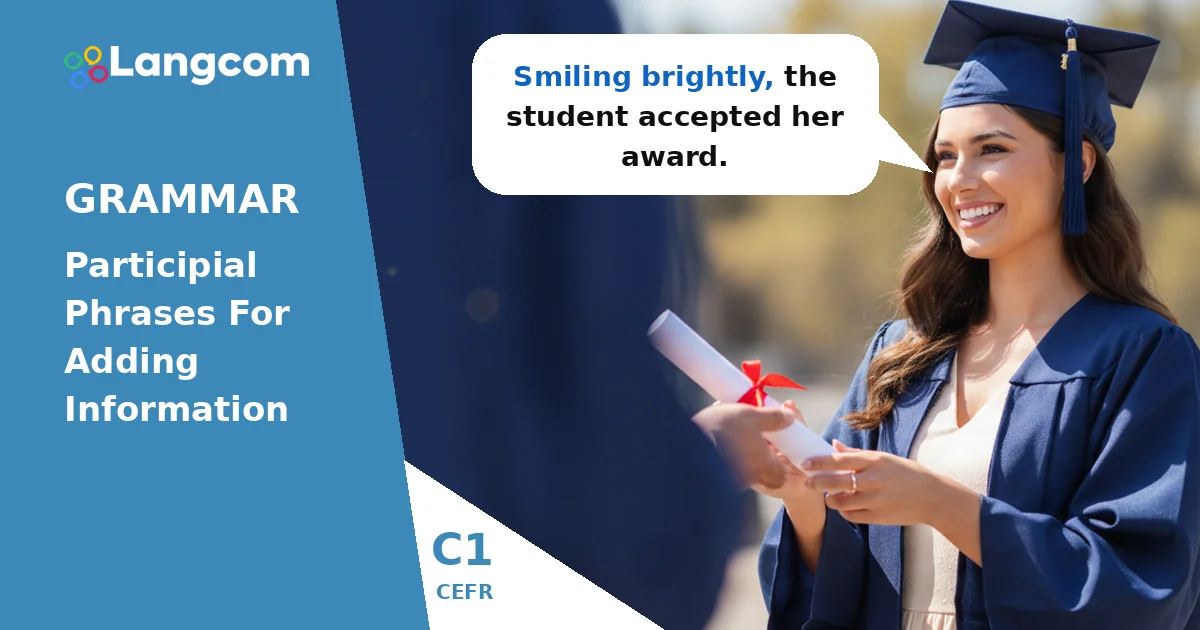
- Smiling brightly, the student accepted her award.
- Having studied for hours, he felt confident about the exam.
- Driven by ambition, she worked tirelessly to achieve her goals.
- Walking through the forest, we heard the birds singing.
- Having completed the first draft, the author took a short break.
- Inspired by nature, the artist created beautiful landscapes.
Übung
Bist du bereit, dein Zertifikat zu erwerben?
Der Kurs Langcom bereitet die Teilnehmer auf die Prüfungen von Cambridge, IELTS, TOEFL, DELE, SIELE und Michigan vor.
Erste Schritte mit LangcomHäufige Fehler bei Spanischsprechern
Spanish speakers sometimes make specific errors when using participial phrases in English:
- Dangling Participles: This happens when the subject of the participial phrase is not the same as the subject of the main clause. The phrase 'dangles' without a clear subject.
Incorrect: Walking home, a dog bit me. (It sounds like the dog was walking home.)
Correct: Walking home, I was bitten by a dog. (I was walking home.) - Incorrect Tense/Aspect: Using a present participle when a perfect participle is needed to show a prior action.
Incorrect: Finishing the report, she sent it to her boss. (Implies finishing and sending happened at the same time.)
Correct: Having finished the report, she sent it to her boss. (Finishing happened before sending.) - Overuse in Informal Speech: While common in writing, these phrases can sound overly formal in casual conversation.
Häufig gestellte Fragen
What is a participle?
A participle is a verb form that can function as an adjective. There are two main types: the present participle (verb + -ing) and the past participle (-ed or irregular form, like written oder seen).
Are participial phrases common in spoken English?
Participial phrases in initial position are more common in formal written English than in spoken English. While you might hear them occasionally, they tend to make speech sound more formal or literary.
Can a participial phrase have its own subject?
No, a participial phrase in initial position does not have its own subject. Its subject is always the same as the subject of the main clause. If the subjects are different, it creates a 'dangling participle' error.
What is the difference between a present and a perfect participial phrase?
A present participial phrase (e.g., Running quickly) describes an action happening at the same time as the main verb. A perfect participial phrase (e.g., Having run quickly) describes an action that happened before the main verb.
How do participial phrases improve writing for C1 exams?
For C1 exams like the Cambridge C1 Advanced (CAE), using participial phrases demonstrates a wide range of grammatical structures, improves coherence, and adds sophistication to your writing. This can help you achieve higher scores in tasks requiring formal written responses.

0 Kommentare