
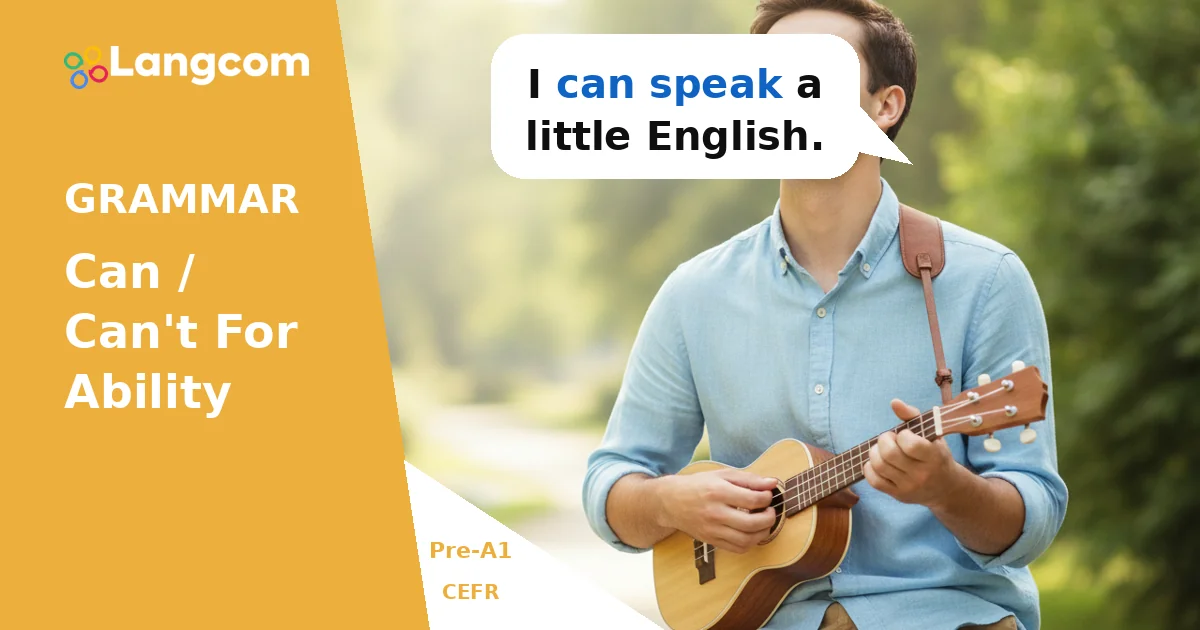

What does ‘Can’ mean in English?
Can is a very useful word in English. We use it to talk about abilities. An ability is something you know how to do.
- Du verwendest can with all subjects: I, you, he, she, it, we, they.
- After can, you always use the base form of the verb. This means the verb without to (z. B., swim, nicht to swim).
Schau dir diese Beispiele an:
- I can speak English. (This is an ability.)
- She can play the guitar. (This is her ability.)
- We can run fast. (This is our ability.)
🎓 Englisch lernen mit der Blended-Methode
Kleingruppen · KI-Tutor rund um die Uhr · Vorbereitung auf die Cambridge-Prüfungen
Pläne von $39 $79 pro Monat
How do we use 'Can't'?
When you want to say you do not have an ability, you use can't. Can't is the short form of cannot.
- Can't means you do not know how to do something.
- Like can, can't also comes before the base form of the verb.
Here are some examples:
- I can't swim. (I do not have this ability.)
- He can't drive a car. (He does not know how.)
- They can't sing very well. (They do not have good singing ability.)
How do we ask questions with 'Can'?
To ask about someone's ability, you put can at the beginning of the sentence.
- Der Aufbau ist wie folgt: Can + Subject + base verb?
Look at these questions and short answers:
- Can you cook?
- Yes, I can. (Affirmative short answer)
- No, I can't. (Negative short answer)
More examples:
- Can she dance?
- Yes, she can.
- Can they speak French?
- No, they can't.
| Frage | Affirmative Answer | Negative Answer |
|---|---|---|
| Can you swim? | Yes, I can. | No, I can't. |
| Can she dance? | Yes, she can. | No, she can't. |
| Can they play football? | Yes, they can. | No, they can't. |
Beispiele
- I can speak a little English.
- My brother can play football very well.
- Birds can fly.
- I can't draw.
- She can't ride a bicycle.
- Can you help me?
- Can he understand Spanish? Yes, he can.
Übung
💬 Benötigen Sie eine individuelle Beratung?
Als autorisiertes Cambridge-Vorbereitungszentrum können wir Ihnen helfen, den richtigen Kurs und die passende Zertifizierung zu finden. Chatten Sie noch heute mit unseren Beratern.
Chatten Sie mit einem Berater auf WhatsAppHäufige Fehler bei Spanischsprechern
Spanish speakers sometimes make these mistakes:
- Using 'to' after can:
I can to swim. (Falsch)
I can swim. (Richtig) - Putting 'not' in the wrong place:
I not can speak English. (Falsch)
I can't speak English. (Richtig) - Changing can for 'he' or 'she':
She cans sing. (Falsch)
She can sing. (Richtig)
Häufig gestellte Fragen
What is 'can' used for?
Can is used to talk about ability, meaning something you know how to do or something that is possible.
What is the short form of 'cannot'?
Die Kurzform von cannot ist can't.
Does 'can' change for 'he' or 'she'?
Nein, can does not change. It is always can for all subjects (I, you, he, she, it, we, they).

0 Kommentare