
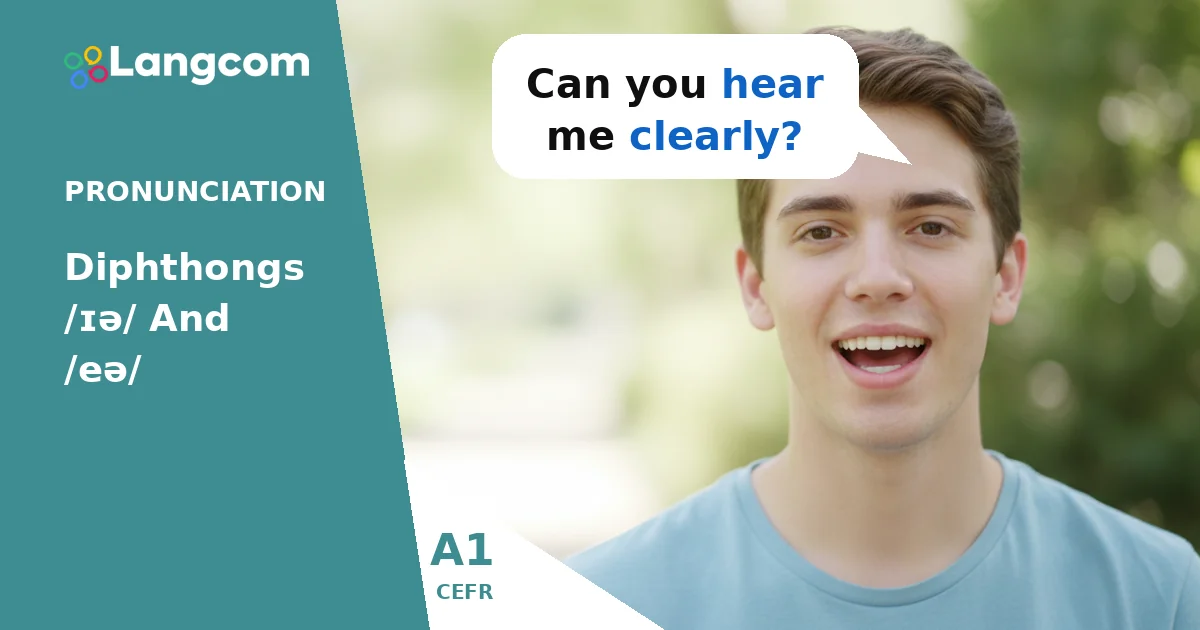

Diphthongs are special vowel sounds that combine two vowel sounds into one smooth sound. For A1 learners, understanding the English diphthongs /ɪə/ (as in here) und /eə/ (as in bear) is important for clear pronunciation. These sounds are not single vowels but a glide from one vowel sound to another within the same syllable. For /ɪə/, your mouth starts with an /ɪ/ sound and moves to /ə/. Für /eə/, it starts with /e/ and moves to /ə/. Mastering these will help you speak and understand English better.
What is a Diphthong Sound?
A diphthong is a vowel sound that changes. It starts with one vowel sound and then moves to another vowel sound in the same syllable.
- Think of it as two sounds working together.
- English has many diphthongs. Today, we focus on two important ones for A1 learners: /ɪə/ und /eə/.
🎓 Englisch lernen mit der Blended-Methode
Kleingruppen · KI-Tutor rund um die Uhr · Vorbereitung auf die Cambridge-Prüfungen
Pläne von $39 $79 pro Monat
How Do You Make the /ɪə/ Sound?
Die /ɪə/ sound is like saying 'ih' then 'uh' very quickly together.
- Start with the short /ɪ/ sound, like in sit.
- Then, move your mouth to the /ə/ (schwa) sound, like in about.
- Your mouth moves slightly as you make the sound.
Common spellings for /ɪə/ include:
- ear: hear, fear, clear
- ere: here, mere
- eer: beer, deer
- ea: idea (at the end)
How Do You Make the /eə/ Sound?
Die /eə/ sound is like saying 'eh' then 'uh' very quickly together.
- Start with the /e/ sound, like in bed.
- Then, move your mouth to the /ə/ (schwa) sound, like in about.
- Again, your mouth moves smoothly from the first sound to the second.
Common spellings for /eə/ include:
- air: hair, chair, fair
- are: care, share, rare
- ear: bear, pear, wear
- ere: there, where
Comparing /ɪə/ and /eə/ Sounds
The main difference between /ɪə/ und /eə/ is the first sound you make.
- Für /ɪə/, you start with a higher, shorter 'ih' sound.
- Für /eə/, you start with a more open 'eh' sound.
- Both sounds end with the same relaxed /ə/ sound.
| Sound | Common Spellings | Example Words |
|---|---|---|
| /ɪə/ | ear, ere, eer, ea | hear, here, beer, idea, clear, fear, mere, deer |
| /eə/ | air, are, ear, ere | hair, care, bear, there, chair, share, pear, where |
Beispiele
- Can you hear me clearly?
- I live near here.
- There is a chair over there.
- Be careful with that pear.
- I have an idea for a career.
- The air is fresh here.
Übung
💬 Benötigen Sie eine individuelle Beratung?
Als autorisiertes Cambridge-Vorbereitungszentrum können wir Ihnen helfen, den richtigen Kurs und die passende Zertifizierung zu finden. Chatten Sie noch heute mit unseren Beratern.
Chatten Sie mit einem Berater auf WhatsAppHäufige Fehler bei Spanischsprechern
Spanish speakers often make these mistakes:
- Pronouncing as a single vowel: Sometimes, learners pronounce here as /hi:/ (like 'hee') instead of /hɪə/. Remember the two sounds.
- Confusing similar words: Words like bear (/eə/) und beer (/ɪə/) sound very different in English. Pay attention to the starting vowel sound.
- Not moving the mouth: The mouth must move slightly to create the glide of a diphthong. Do not keep your mouth still.
Häufig gestellte Fragen
What is the difference between a monophthong and a diphthong?
A monophthong is a single, pure vowel sound, like /i:/ in sheep. A diphthong is a combination of two vowel sounds that glide from one to the other within the same syllable, like /ɪə/ in here.
How can I practice these diphthong sounds?
Listen to native speakers carefully. Repeat words like here und hair many times. Record your voice and compare it to a native speaker. Focus on the movement of your mouth.
Are there other diphthongs in English?
Yes, English has several other diphthongs, such as /aɪ/ (as in my), /oʊ/ (as in go), und /aʊ/ (as in now). For A1, focusing on /ɪə/ und /eə/ is a great start.



0 Kommentare