

What is the Past Simple of ‘To Be’?
The verb ‘to be’ changes in the past simple. It has two forms: was und were.
- Wir verwenden was for singular subjects: I, he, she, it.
- Wir verwenden were for plural subjects: you, we, they.
These forms help us talk about how things were in the past.
🎓 Englisch lernen mit der Blended-Methode
Kleingruppen · KI-Tutor rund um die Uhr · Vorbereitung auf die Cambridge-Prüfungen
Pläne von $39 $79 pro Monat
How Do We Make Negative Sentences?
To make a negative sentence with 'to be' in the past simple, we add not danach was oder were.
- The full forms are was not und were not.
- The common short forms are wasn't und weren't.
These short forms are very common in everyday spoken English.
Wie stellen wir Fragen?
To ask a question with 'to be' in the past simple, we change the word order. We put Was oder Were at the beginning of the sentence, before the subject.
- For example, instead of You were happy, we ask Were you happy?
- Für kurze Antworten verwenden wir Yes, I was oder No, I wasn't.
This structure is important for asking about past situations.
When Do We Use the Past Simple of 'To Be'?
We use the past simple of 'to be' to talk about:
- Past states or conditions: She was tired yesterday.
- Past locations: They were at the park.
- Past descriptions: The weather was cold.
- Past facts: It was my birthday last week.
It helps us describe situations that are now finished.
Beispiele
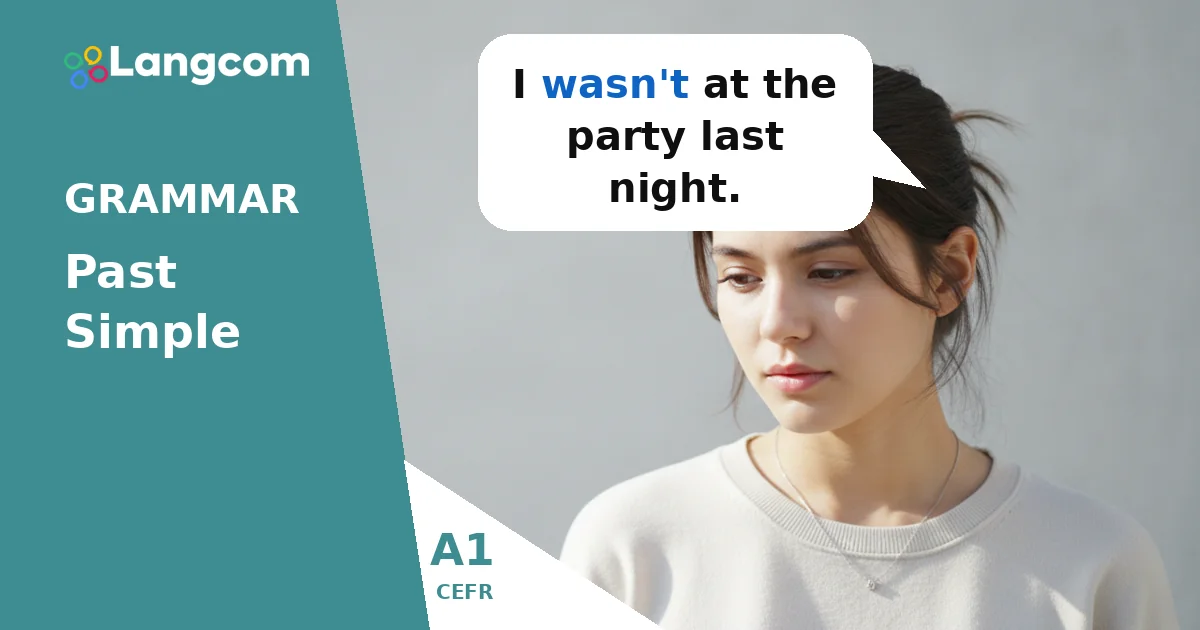
- I wasn't at the party last night.
- She wasn't happy with the food.
- We weren't friends in high school.
- They weren't ready for the exam.
- Was he busy on Monday?
- Were you at home yesterday afternoon?
- Was it a good movie?
- Were they late for the meeting?
Übung
💬 Benötigen Sie eine individuelle Beratung?
Als autorisiertes Cambridge-Vorbereitungszentrum können wir Ihnen helfen, den richtigen Kurs und die passende Zertifizierung zu finden. Chatten Sie noch heute mit unseren Beratern.
Chatten Sie mit einem Berater auf WhatsAppHäufige Fehler bei Spanischsprechern
Spanish speakers sometimes make mistakes when using 'to be' in the past simple, especially with negatives and questions.
- Using 'did not be': A common error is to say I didn't be happy. This is incorrect. The correct form is I wasn't happy. Remember, 'to be' does not use 'do' in the past simple for negatives or questions.
- Incorrect word order in questions: Another mistake is to say You were tired? statt Were you tired? In English questions, 'was' or 'were' must come before the subject.
- Confusing 'was' and 'were': Ensure you use was für I, he, she, it und were für you, we, they. Zum Beispiel:, We was late is wrong; it should be We were late.
Häufig gestellte Fragen
What is the difference between 'was' and 'were'?
Wir verwenden was for singular subjects (I, he, she, it) und were for plural subjects (you, we, they) when talking about the past.
Can I use 'was not' instead of 'wasn't'?
Yes, you can. Was not ist die vollständige Form, und wasn't is the contracted (short) form. Both are correct, but wasn't is more common in spoken English and informal writing.
How do I answer 'yes/no' questions with 'to be' in the past?
You use short answers. For example, if someone asks Was she at home?, you can say Yes, she was oder No, she wasn't. If they ask Were they busy?, you say Yes, they were oder No, they weren't.


0 Kommentare